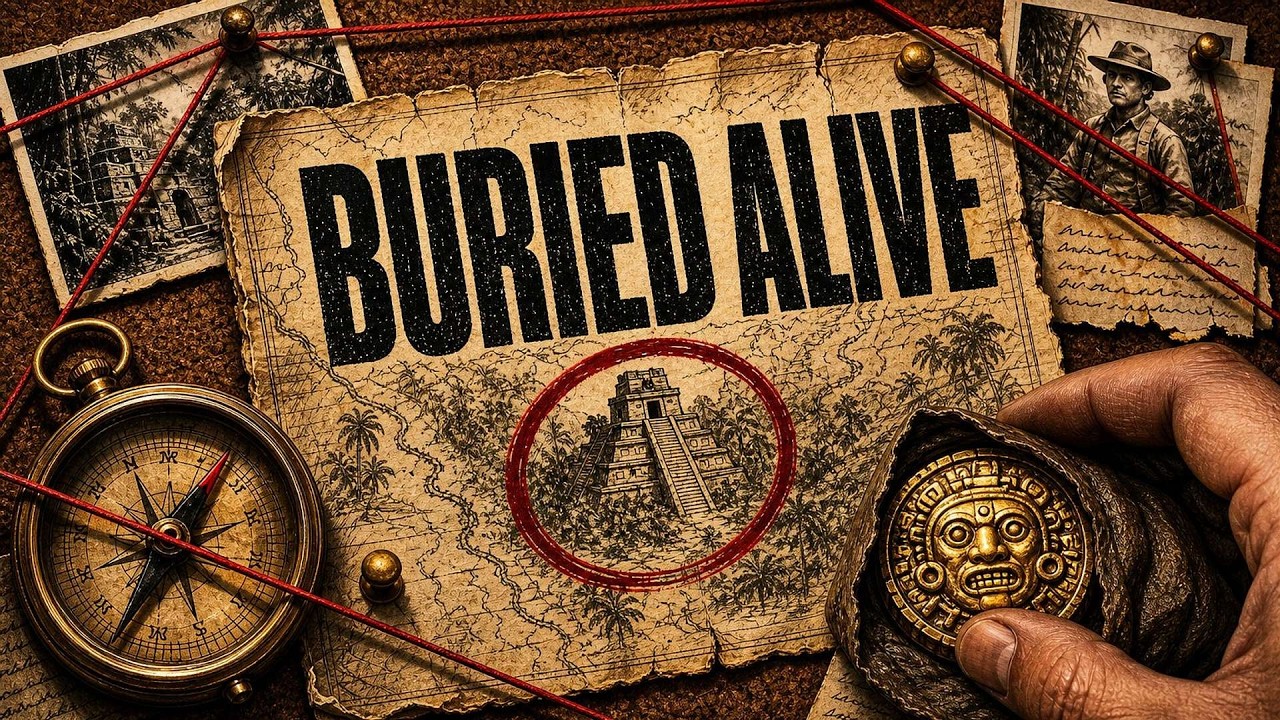
Manuscript 512 Decoded: Did Brazilian Bandeirantes Really Find a Roman-Style Lost City in the Amazon?
Manuscript 512 is a 10-page 1753 document detailing an abandoned Amazonian stone city featuring Roman-style triumphal arches, obelisks, and a mysterious gold coin. While mainstream history dismisses it as colonial fantasy, its uncanny architectural descriptions and startling parallels to modern archaeological discoveries in the Brazilian rainforest continue to puzzle alternative historians and researchers.
Key Takeaways
- Manuscript 512 describes an abandoned, multi-room Amazonian stone settlement discovered by Portuguese Bandeirantes in 1753.
- The text details bizarre structural anomalies like Roman-style arches, obelisks, and a black pedestal statue pointing north.
- A recovered gold coin depicted old-world iconography, including a kneeling boy, a bow, an arrow, and a royal crown.
- Modern Amazonian discoveries like Terra Preta and geometric earthworks validate that large-scale civilizations once thrived in the jungle.
- The document's exact author remains unknown, and its physical site has never been conclusively located by modern expeditions.
The Accidental Discovery in Rio de Janeiro
In 1839, a naturalist named Manuel Ferreira Lagos was sifting through archives in the National Library of Brazil in Rio de Janeiro when he stumbled upon a yellowed, fragile document. Cataloged as Manuscript 512, its full title translates roughly to a historical relation of a hidden, large, very old settlement with no inhabitants found in the year 1753. For decades, the document gathered dust, viewed merely as an eccentric piece of colonial folklore. That was until a seasoned British geographer and explorer named Percy Fawcett crossed paths with it.
Fawcett was not a man easily fooled by tall tales. Having spent nearly two decades mapping hostile South American borders and serving in British intelligence, he understood the harsh realities of the Amazon basin. Yet, when he read the ten-page account of a hidden jungle metropolis, it fundamentally shifted his worldview. The manuscript was written by an anonymous hand, recounting the arduous ten-year journey of a band of Portuguese Bandeirantes—semi-autonomous fortune hunters who pushed deep into the interior of Bahia and Mato Grosso in search of legendary silver and gold mines.
Who Were the Bandeirantes?
The Bandeirantes were a rough-hewn breed of men, driven by the crown's thirst for precious metals and their own survival. They were not trained archaeologists or cartographers; they were pragmatic frontiersmen. When they stumbled upon the ruins described in Manuscript 512, they were starving, exhausted, and desperately trying to survive a decade-long expedition. Their pragmatic nature adds weight to their account: these were not men prone to romanticizing their surroundings unless the reality before them was too striking to ignore.
Architectural Anomalies: Roman Arches in the Amazon
The most provocative aspect of Manuscript 512 is not simply that it describes ruins, but *what* kind of ruins it describes. According to the text, the Bandeirantes entered the abandoned city through a monumental triple archway. This structure bore an unmistakable resemblance to a Roman triumphal arch, complete with foreign inscriptions that none of the men could read or translate.
As they ventured deeper into the settlement's main square, they encountered a black stone pedestal supporting the statue of a man with his hand pointing directly north. Surrounding the plaza were towering obelisks, styled identically to Roman spires, along with buildings featuring intricate reliefs of crosses, crows, and geometric patterns. In an era when European academia taught that the indigenous peoples of the Amazon were strictly nomadic hunter-gatherers incapable of monumental architecture, a description of Roman-style arches and obelisks in the heart of Brazil was nothing short of blasphemous.
The Mystery of the Old-World Gold Coin
Perhaps the most confounding artifact mentioned in the document is a gold coin discovered in a fifteen-room manor house by a explorer named Joan Antonio. The coin's imagery defied every known pre-Columbian cultural standard. One side depicted a young boy kneeling, while the reverse displayed a bow, an arrow, and a crown. No Incan, Mayan, or Amazonian civilization ever minted currency featuring European-style regal crowns or classic boy-and-arrow motifs. For Fawcett, this coin was the smoking gun indicating pre-Columbian trans-oceanic contact.
Modern Archaeology Confirms Amazonian Complexity
For a century, mainstream academia treated Manuscript 512 as a fabrication born of tropical heat and colonial hubris. However, late 20th and early 21st-century archaeology has completely upended traditional views of the Amazon. Utilizing advanced satellite imagery, LiDAR, and ground surveys, researchers have uncovered massive geometric earthworks, sprawling defensive ditches, and hundreds of acres of Terra Preta—dark, man-made agricultural soil created by ancient populations.
We now know beyond a shadow of a doubt that the Amazon supported complex, densely populated societies long before European ships arrived. Yet, a glaring disconnect remains. While modern science has proven that large Amazonian civilizations existed, the specific architectural markers detailed in Manuscript 512—the Roman-style triple arches, the obelisks, and the laurel-crowned reliefs—have never been recovered. The physical site described by the Bandeirantes remains elusive, leading many to wonder if the jungle has permanently reclaimed a lost chapter of human history.
Conclusion: Unraveling the Enigma
Manuscript 512 stands as one of history's most tantalizing archival curiosities. Whether it represents a genuine record of a forgotten Mediterranean-style colony in the South American interior, an embellished campfire tale told by desperate fortune hunters, or an elaborate historical hoax, it fundamentally changed the trajectory of exploration history by luring Percy Fawcett into the green abyss. As modern technology slowly peels back the dense canopy of the rainforest, the boundary between myth and historical reality continues to blur.
To hear the full story of Fawcett's fateful expedition, his obsession with the lost city of Z, and the eerie historical connections to King Solomon's mines, check out the complete audio investigation. Listen to the full episode and join us in the shadows as we explore history's most impenetrable mysteries.