The Mad Gasser of Mattoon: When a Town Turned Fear Into a Villain
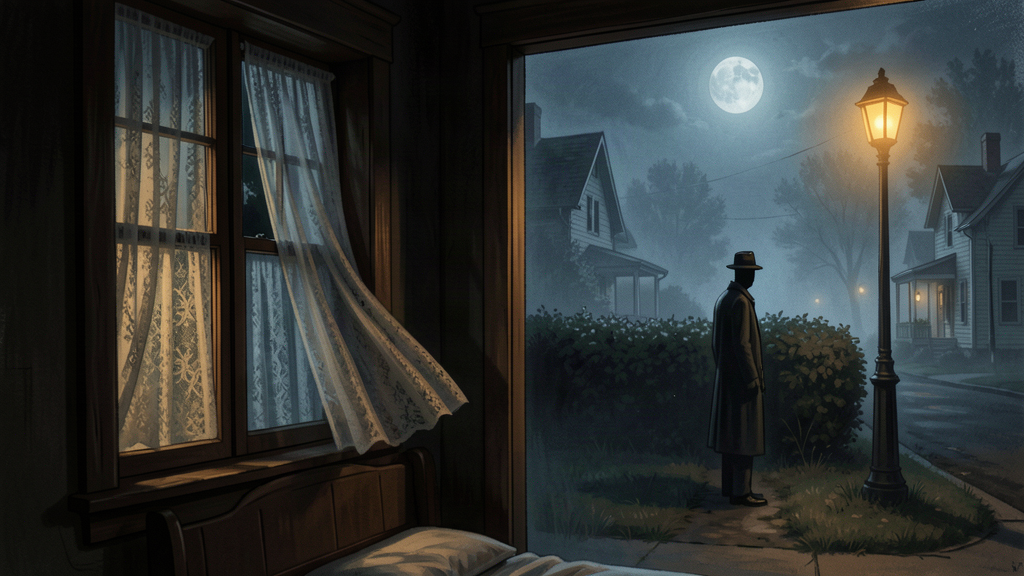
In September 1944, a woman lay in bed in a small Illinois town and smelled flowers where no flowers could be. The odor was sweet and faint, out of place on a warm night in the middle of Mattoon, and before she could make sense of it her legs would not move. Her throat tightened. Her husband, looking out into the dark, would later swear he saw a tall, thin figure in dark clothing standing outside the same window. No locks were broken. Nothing was stolen. No chemical residue was ever found. Yet the town suddenly had a name for the dread: the Phantom Anesthetist, soon known around the world as the Mad Gasser of Mattoon.
Russ Chamberlin tells the full story of those twelve nights in the Mad Gasser of Mattoon episode of Midnight Signals, walking listeners from the first complaint to the final headline. This article follows one thread that story keeps pulling on: how a town already stretched thin by war and worry could assemble a villain out of a smell.
A town already afraid
Mattoon in 1944 was not an ordinary small town. America had been at war for nearly three years. Families were missing members serving overseas, and the home front was saturated with warnings about gas attacks, sabotage, and invisible dangers. Chloropicrin, tear gas, and other chemical agents had entered the national conversation, and a nervous public had learned to treat strange smells as threats.
That context matters. The panic did not begin in a vacuum; it began in a place that had already been taught, daily, to fear the air itself. When a woman reported a sweet odor and a strange weakness, her neighbors did not hear an isolated incident. They heard a confirmation of a fear they had been rehearsing for years.
The first night and the multiplying reports
The account that seeded the legend began in the Kearney home on the night of September 1, 1944. A sweet, floral odor filled the bedroom. Aline Kearney found she could not move her legs, and her throat tightened. Her husband Bert, checking the yard, said he saw a tall, thin man in dark clothing near the window, holding what looked like some kind of device. The police found nothing.
But the story had a shape now. Within days, reports multiplied across Mattoon. Odd odors, nausea, dizziness, weakness. Some residents claimed to see a blue vapor. Others described a buzzing sprayer device. A damp cloth found near a porch looked like the first hard proof of a chemical attack, until a laboratory in Chicago tested it and found nothing. No gas. No residue. The evidence evaporated while the fear did not.
The weapon that was never found
What made the case so stubborn is precisely what made it so compelling. There was no common toxin. The reported symptoms varied from home to home, the smells were never consistent, and no one ever recovered a sprayer, a chemical, or a poisoner. Police searched yards and questioned suspects. Citizen posses took to the streets armed with shotguns, creating a new danger that had nothing to do with any phantom. The pursuit of an invisible attacker had begun to endanger the town it was meant to protect.
When national reporters arrived, the story shifted from terror to spectacle. Newspapers that had warned of an airborne menace cooled their tone. Officials floated an industrial solvent theory. And almost as quickly as it had begun, the wave of reports faded. By the twelfth night, the Mad Gasser had not been caught. He had simply stopped being news.
Mass hysteria, or a real match?
The case has never fully closed. In 1945, psychologist Donald M. Johnson analyzed the events and argued that the Kearney story gave the town a model for interpreting its anxiety. Once a single vivid account existed, every strange odor and every flutter of nerves could be read as an attack. The panic spread because the story spread, not because a poisoner did.
Modern writers often prefer the phrase collective anxiety to mass hysteria, a shift that reflects how the phenomenon is understood today: not a gullible crowd, but a community under real stress interpreting genuinely ambiguous sensations through a single frightening frame. Anxiety might explain how the reports multiplied, though — as the episode makes clear — it may not explain what started the first night.
The unanswered question
Here is the thread that keeps the Mad Gasser from being dismissed as a mere hoax. It is entirely possible that one real incident lit the match. A stove, a train, an insecticide, a factory, a coincidence of an ordinary prowler and wartime nerves. There may never have been a man moving window to window with a spray gun. But there may have been a genuine odor, an intruder, or an exposure that caused real illness before the legend swallowed it whole. One event can be real while the story built around it becomes something else — a single match starting a fire far larger than itself.
By the twelfth night, the Mad Gasser had become the shape the town gave to invisible danger, gathering everything that could not be seen or controlled: the war, the chemicals, the absent family members, the noises after midnight. He was the name Mattoon gave to its own fear.
Listen to the full story
There is far more to the twelve nights than any article can hold — the posses, the contradictory testimonies, the eerie details that refuse to line up. Russ walks the whole case in The Mad Gasser of Mattoon: Twelve Nights of Sweet Air. Press play, then decide for yourself: was there a hidden attacker, a brief exposure, or fear feeding on itself?
The prisoner they lowered into Houska