The prisoner they lowered into Houska
They never kept his name.
That is the first thing that stays with me about the Houska story. Not the castle. Not the chapel. The missing name. A young man already marked for death, offered a rope and a pardon, and the folklore only remembers what came back up.
If you have already heard Russ Chamberlin walk the fortress on Midnight Signals, you know the wider map: a 13th-century royal house in the Kokořínsko woods, raised in the reign of Přemysl Otakar II, sitting on rock that feels chosen for the wrong reasons. This is not that map again. This is the one figure the chronicle never bothered to identify.
A pardon with a hole in it
The historical Otakar II, sometimes written Ottokar, was a real king of Bohemia. He needed administrators, estates, stone. Folklore gives him a different errand. Word reached the court that a fissure in the cliff would not fill. Stones went in and made no sound. Animals would not graze the hill. After dark, shapes that were not quite livestock and not quite men were said to leave the opening.
No soldier would go down. So the story turns to a condemned prisoner. The bargain is simple enough to feel true even if no ledger records it. Descend on a rope. Come back with a report. Walk free.
He is described as young and healthy. Faced with the gallows, he accepts. Of course he does. A pardon is a kind of light. The pit is only a rumor until you are hanging over it.
Minutes that last thirty years
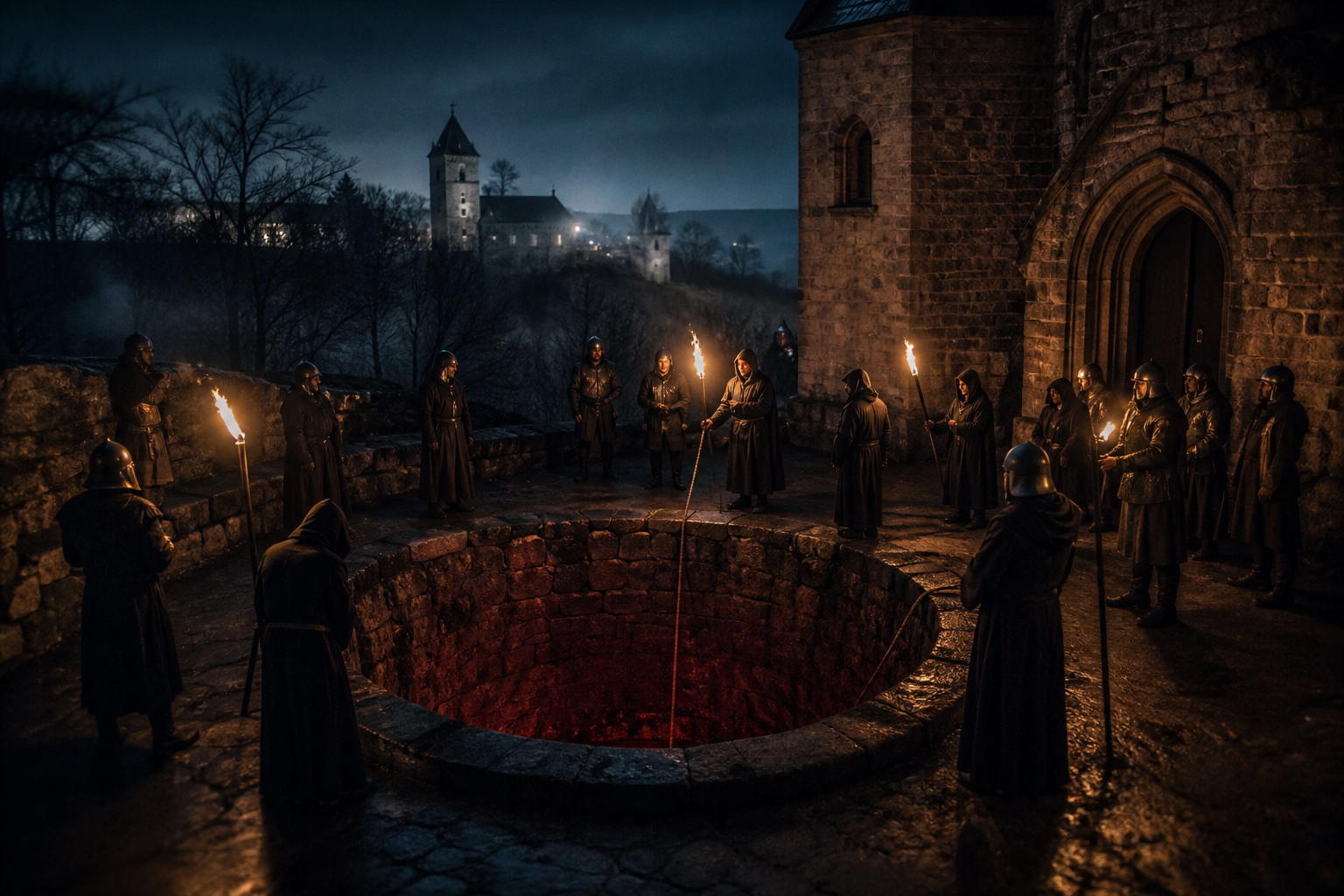
Men gather at the lip. The rope takes his weight. For a few breaths, nothing. Then the screaming starts, and the tellers are careful about the kind of scream. Not a slip. Not a cracked rib against limestone. The sound of a mind meeting something it cannot keep.
They haul him up as fast as they can. The man who surfaces is not the one they lowered. Hair gone white. Face lined. Skin hanging as if decades had passed in the dark. He shakes. He cannot finish a sentence. Between the panic he babbles about shapes moving below and things reaching from inside the rock.
The versions disagree on the exact count. Some say a few minutes. Some say he looked thirty years older, some sixty. They agree on the white hair, the ruined speech, and the short life afterward. The legend usually sends him to confinement, then to an early grave. Nobody remembers his name. The legend remembers only the return.
There is no parish register for this man. No death notice that a modern historian can hold up. Later writers treat the lowering as folklore attached to Houska by the 17th and 18th centuries, already old when it was written down. That does not make the story smaller. It makes the anonymity louder. A kingdom can archive a king. It does not archive the first person it fed to a hole.
What a nameless descent is for
Listen close and the tale is doing work. It tells you the pit is not a well you can survey. It tells you curiosity is a kind of sentence. It tells later builders why the next move is not another volunteer, but stone.
After that descent, the folklore says, no one else volunteered. The king had his answer. Whatever waited under the hill was not to be mapped. It was to be closed. Workers covered the opening. A chapel rose over it. The prisoner becomes the reason the seal exists.
I keep thinking about the rope. Someone had to hold it. Someone had to feel the moment the weight changed, when the screaming traveled up the fibers into their palms. Folklore almost never stays with those hands. It stays with the white hair, because white hair is a picture you can carry out of the woods.
Why the story still pulls
We want a witness. The Houska legend refuses to give us a reliable one. The only person said to have seen the bottom (or to have learned there is no bottom) comes back unable to testify. That is a cruel narrative trick, and a durable one. If he could have described it cleanly, the hill would be geology. Because he could not, the hill stays a warning.
If you want the full night around this figure, the inward-facing walls, the chapel, the later centuries that stacked new dread on old stone, start here: The Czech Castle Built To Cover Hell
Then sit with the part the episode cannot close. A pardon was offered. A rope went down. A nameless man came back aged, raving, and already leaving this world. The castle is what the living built so they would never have to lower anyone again.
How the Lesser Key of Solomon Evolved From Ancient Apocrypha