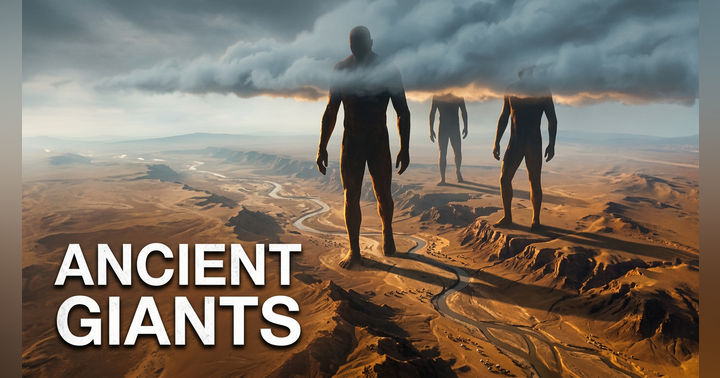
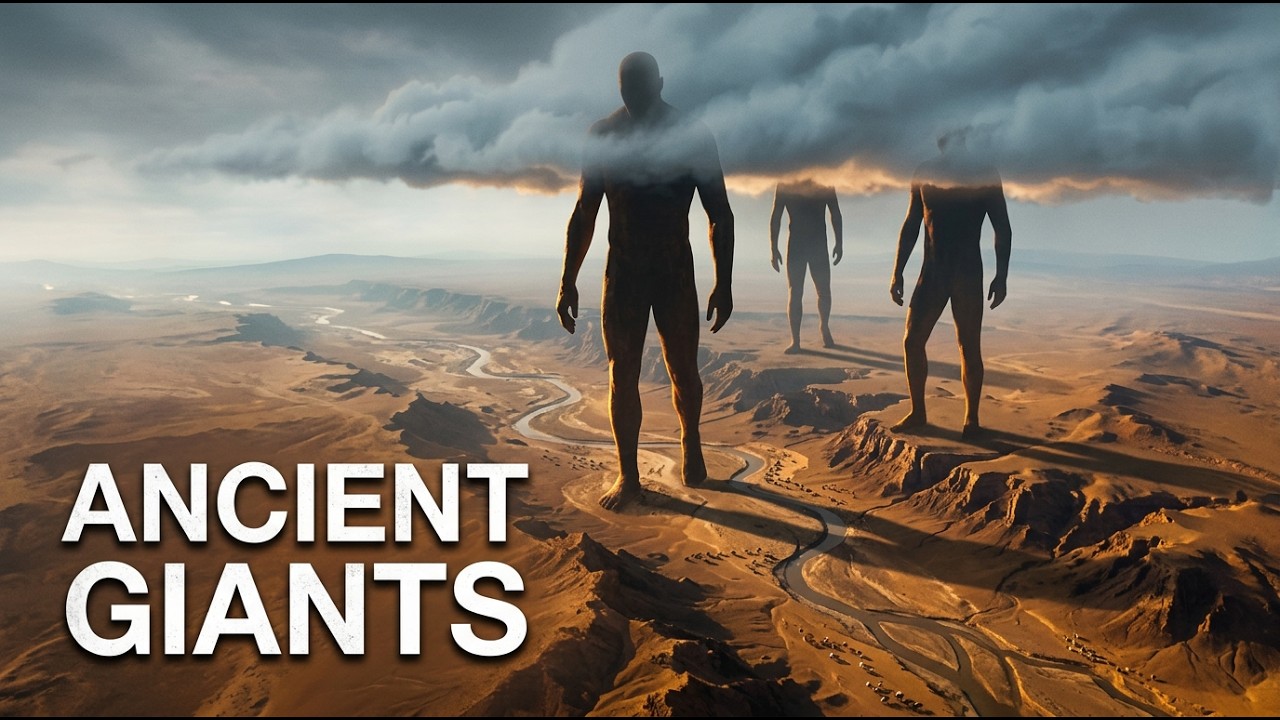
4,000 Cubits: The Giants Who Reached the Clouds


Key Takeaways
- The Source Text: The Dead Sea Scrolls, discovered in 1947, include the Book of Giants — a non-canonical text describing Nephilim offspring of colossal size, named individually and given their own narrative arc.
- The Measurement: 4,000 cubits translates to approximately 6,000 to 6,900 feet tall — and this episode argues the writers intended it as a literal biological record, not poetic hyperbole.
- Pre-Flood Atmospheric Theory: A dense water-canopy atmosphere and significantly higher oxygen levels in the pre-Flood world could have supported gigantism on a scale impossible in today's environment.
- Petrification, Not Decay: The catastrophic flood burial theory suggests that immense pressure and silicification transformed giant remains into solid rock — not fossil bone, but entire mountain formations.
- A Buried History: The Book of Giants was deliberately excluded from canonical scripture, and this episode examines why its contents were considered too disruptive to preserve in plain sight.
In 1947, a teenage shepherd stumbled into a cave in the Judean desert and pulled open a door to a forgotten world. Welcome to Midnight Signals, where host Russ Chamberlin investigates the histories that were never meant to be found. In this episode, we open the Book of Giants, one of the Dead Sea Scrolls, and follow its account of beings so massive their heads brushed the clouds. The question is not whether the ancient writers believed it. The question is whether they were recording something real.
The Book of Giants and the Nephilim Lineage
The Dead Sea Scrolls contained 900 manuscripts recovered across 11 caves near Qumran. Among them was the Book of Giants — a text detailing the offspring of the Watchers and human women, known as the Nephilim. Unlike the brief mention in Genesis, this text names individual giants: Oya, Hahya, Mahua, and — strikingly — Gilgamesh, a figure previously known only from Mesopotamian epic tradition.
Russ Chamberlin walks through the significance of these names appearing in a Jewish desert text and what it suggests about the shared mythological memory of the ancient Near East. These were not metaphors. They were individuals with identities, dreams, and a growing awareness that extinction was coming for them.
Mountains of Flesh: The Geology of Giants
If beings of this scale existed and were killed by a catastrophic global flood, where did they go? This episode proposes an answer rooted in geology. Under conditions of rapid burial and extreme pressure, organic tissue does not decay — it mineralizes. The process of silicification, which transforms soft tissue into solid stone, would have operated at extraordinary scale if the buried organisms were thousands of feet tall.
Russ Chamberlin examines the argument that specific mountain ranges — particularly portions of the Appalachian chain and the Ural Mountains — display formations consistent with this theory. What geology labels as natural uplift, this line of inquiry identifies as the calcified remains of a civilization of giants, pressed into the bedrock beneath our feet.
Timestamps
(00:11) The Shepherd and the Cave — The 1947 discovery of the Dead Sea Scrolls and the contents no one expected.
(01:05) What the Scrolls Contained — The scope of the 900+ manuscripts and the specific significance of the Book of Giants.
(02:30) The Nephilim Named — Introducing Oya, Hahya, Mahua, and Gilgamesh as individual figures within the text.
(04:15) The Math of 4,000 Cubits — Converting the measurement and evaluating whether it was meant literally.
(06:00) The Pre-Flood Atmosphere — The water-canopy model and atmospheric conditions that made extreme gigantism biologically plausible.
(08:20) Why Giants Could Exist — Oxygen density, pressure, and the biology of scale in a denser world.
(10:05) The Flood as Extinction Event — How the catastrophic burial scenario applies to beings of this size.
(11:50) Silicification: Flesh Becomes Stone — The process by which organic tissue can mineralize under extreme pressure.
(13:30) The Appalachians and the Urals — Examining specific mountain formations through the lens of the giant-remains theory.
(15:15) Prophetic Dreams of the End — Oya and Hahya's visions of destruction and the search for Enoch to interpret them.
(17:00) Excluded From Scripture — Why the Book of Giants was removed from canon and what that decision preserved — or suppressed.
(18:45) What the Ground Remembers — Closing reflection on the possibility that the giants didn't disappear — they became the landscape.
The Discovery at Qumran
In 1947, a teenage shepherd boy climbed into a cave in the Judean Desert and discovered clay jars sitting in the dark, where they had remained sealed and untouched for 2,000 years. Inside those jars lay dozens of scrolls, and one of those ancient documents describes living creatures so massive that their heads brushed the clouds. The scribe who recorded the account wrote down a specific measurement of 4,000 cubits, and that number remains visible on the fragment to this day.
While most scholars read past the figure and dismiss it as mere hyperbole, a different question emerges if we consider that the scribe wasn't being poetic. If 4,000 cubits was intended as a literal record, the implications for our understanding of the ancient world change entirely.
The cave discovered by that shepherd was only the beginning of a much larger find. Over the following years, archaeologists identified 11 different caves in the cliffs above Qumran, and every one of them contained scrolls or fragments that time had shredded into pieces, often no larger than a human palm. When the long process of sorting finally ended, the count reached approximately 900 manuscripts written in Hebrew, Aramaic, and Greek. These texts covered everything from biblical books and calendars to strict community rules.
The Book of Giants and the Nephilim
Yet hundreds of these documents never appeared in any modern Bible. These weren't lost works so much as they were deliberately set aside by later religious authorities. One of the most striking texts left out of the canon was the Book of Giants, written in Aramaic and recovered from multiple caves. The work belongs to a tradition far older than the Qumran community, and it centers on the figure of Enoch, whom Genesis describes as a man who walked with God before vanishing.
The Book of Giants functions as a missing file within this tradition, expanding on the brief mention in Genesis 6 regarding the "sons of God" taking human wives. While the Bible offers only two verses on the Nephilim, this text provides a detailed account of what those offspring were, how they lived, and the eventual fate that met them.
The Watchers is the specific name the text uses for the angels who descended to Earth, and their actions crossed a line that the ancient writers treated as a biological catastrophe. By taking human women as partners, they produced children who were neither fully human nor fully angelic. This species was something the pre-flood world had never seen before, and the Book of Giants serves as the primary record of their existence.
The specificity of this text is what separates it from standard mythology, as the beings described are not nameless monsters used to explain away evil. They have distinct names like Oya and Hahya, who were brothers and the sons of the Watcher Shemehaza, while another figure named Mahua is identified as the son of the Angel Barakel. Even Gilgamesh makes an appearance, and his presence in this Aramaic text shows how deeply this tradition had spread across the ancient Near East. These are treated as individuals with recorded conversations, anxieties, and decisions, which suggests the author was documenting people rather than creating symbols.
The Math: Measuring the Impossible
For decades, the Book of Giants remained stuck in academic holding while fragments were cataloged and debated in obscure journals. The public didn't gain full access to the Dead Sea Scrolls until the 1990s, which was more than 40 years after the initial discovery in the desert. The fragments belonging to the Book of Giants were among the very last to receive serious translation, and whether that delay was a coincidence is something for the reader to weigh.
What remains is a pre-flood world described in physical terms, and once we look at the actual math behind the scribe's measurements, the numbers become impossible to ignore. The cubit represents the distance from a man's elbow to his fingertip, which usually measures about 18 inches, though the Egyptian royal cubit was slightly longer at 20.6 inches. This unit stands as one of the oldest standardized measurements in human history, and it was used by Mesopotamian architects, Hebrew priests, and Egyptian builders for thousands of years of recorded construction. When Moses describes the dimensions of the Ark, he uses cubits, and when Ezekiel maps the dimensions of the future temple, he uses cubits as well. Even the height of Goliath recorded in the Book of Samuel is measured in cubits, which shows this was never a vague or poetic unit.
So when the Book of Giants records a height of 4,000 cubits, it is using that exact same system of measurement. If you run the numbers using the standard 18-inch cubit, you land at 72,000 inches, which equals 6,000 feet. That is more than a mile of biological mass standing upright. And if you use the Royal Egyptian cubit, the height reaches closer to 6,900 feet. Either way, the text describes something that simply does not fit into any category modern biology has ever built.
A High-Pressure Pre-Flood World
Most scholars look at that number and immediately dismiss it as hyperbole. But the problem is that the text does not read like an exaggeration. Hyperbole usually announces itself by reaching for an emotional effect or using flowery comparisons. The Book of Giants records 4,000 cubits the same way a scribe would record a tax figure or a census count. Unrelated civilizations separated by both geography and language—like the Sumerian King List—all recorded pre-flood figures as operating on a scale that dwarfs anything that came after the cataclysm.
The world these sources were documenting was a completely different physical environment than the one we know today. Genesis describes a water canopy existing above the atmosphere, and this layer would have created environmental conditions that are impossible under our current sky. This canopy likely produced much denser atmospheric pressure and a higher concentration of oxygen while dramatically reducing the amount of ultraviolet radiation reaching the ground.
We already know that oxygen levels and atmospheric pressure govern the scale of biological life, which is why insects in the Carboniferous period grew to sizes that are impossible now. A pressurized, high-oxygen environment in the pre-flood world would not just allow for larger organisms, but it would actively select for them. The giants were not a miracle or a metaphor; they were the predictable biological result of an atmosphere that was eventually destroyed.
Petrification: Mountains of Flesh
That world is gone now, but the things that lived in it did not just vanish when the canopy collapsed and the water rose. According to the atmospheric model, the canopy did not thin out gradually, but instead collapsed entirely, causing the pressure and oxygen levels to drop instantly. Every living thing above a certain size died in an environment that could no longer support its weight.
These creatures were buried under water and sediment moving with catastrophic force. Normal decomposition requires oxygen and microbial activity, but a biological mass caught in a massive sediment event gets buried under thousands of feet of earth before it can even begin to rot. As the pressure builds, minerals from the surrounding water and rock begin replacing the organic tissue cell by cell in a process called silicification. This is the same process that turns a fallen log into petrified wood. Given enough pressure and time, you end up with something that looks exactly like rock from the outside because the rock literally grew inside the biology.
Certain geological formations across every continent on Earth fit this description perfectly. The Appalachian range has puzzled geologists because its folding looks less like lateral tectonic pressure and more like biological tissue compressed from above. The Urals and many formations in the Middle East have internal structures openly described as anomalous. Silicified organic material is chemically identical to silicate rock, so if you aren't looking for biology, you will never find it.
Ancient cultures that had no contact with each other managed to preserve this exact same story in their folklore. On every inhabited continent, there are accounts of giant beings whose bodies eventually became the land itself. Their bones became the ridgelines, their flesh became the earth. What remains today is not an absence of evidence, but a massive amount of mineralized, load-bearing mass that we now treat as natural resources. We have built our entire civilization on their remains without ever truly knowing what we are standing on.
The Prophetic Dreams of Extinction
Long before the first rains fell, the giants began to dream. The Book of Giants records the experiences of Oya and Haya during the days leading up to the flood. These two brothers started having vivid dreams that they simply could not explain away. Oya described seeing the ruler of heaven descending toward the Earth while thrones were being prepared and books were opened for a sentence to be read aloud. Another giant named Mahwe saw a tablet submerged in water; when it was pulled back up, almost every name once written on it had been erased.
They gathered together to compare their visions and decided they needed to find Enoch. He was the only person outside their own bloodline who had access to the kind of knowledge that could explain how much time they had left. When Mahwe finally arrived, Enoch handed him written tablets containing formal interpretations of the dreams.
The interpretation confirmed the worst fears of the giants: a massive flood was coming to destroy them. Their fathers, the Watchers, had already been bound and imprisoned, which meant the giants were now the very last of their line. Most myths give you heroes who defy their fate, but these giants simply panicked and grieved. Some of them even tried to shift the blame onto Azazel, hoping that spreading the guilt around might change their sentence. They were forced to realize that a world built specifically for them was already over.
A Buried History
The Book of Giants was not some obscure or hidden text. The community at Qumran actually treated it as a piece of holy scripture, and the Manichaean tradition kept their own version of it alive for hundreds of years. It only became a marginal document much later, after specific leaders made decisions about which books would represent the official tradition.
The real issue was what the text implied if you actually believed it. If the giants were physical beings with recorded heights, then the Watchers who fathered them had to be real biological entities as well. If you accept that the biology was real, then the flood was not just a local river overflowing, but a global extinction event for an entire species. That specific chain of logic is why the text was eventually filed away and forgotten by the mainstream.
When the canopy finally collapsed and the flood buried every living thing beneath it, the world that allowed mile-tall biology to thrive was sealed away forever. All that survived was a geological record made of mineralized, load-bearing stone on a continental scale, along with a few Aramaic fragments that the public rarely sees. The official history books stop at the surface, but the evidence suggests a much larger story buried underneath.