4,000 Cubits: Were the Giants of Ancient Texts Real, and Are Their Remains Hiding in Plain Sight?
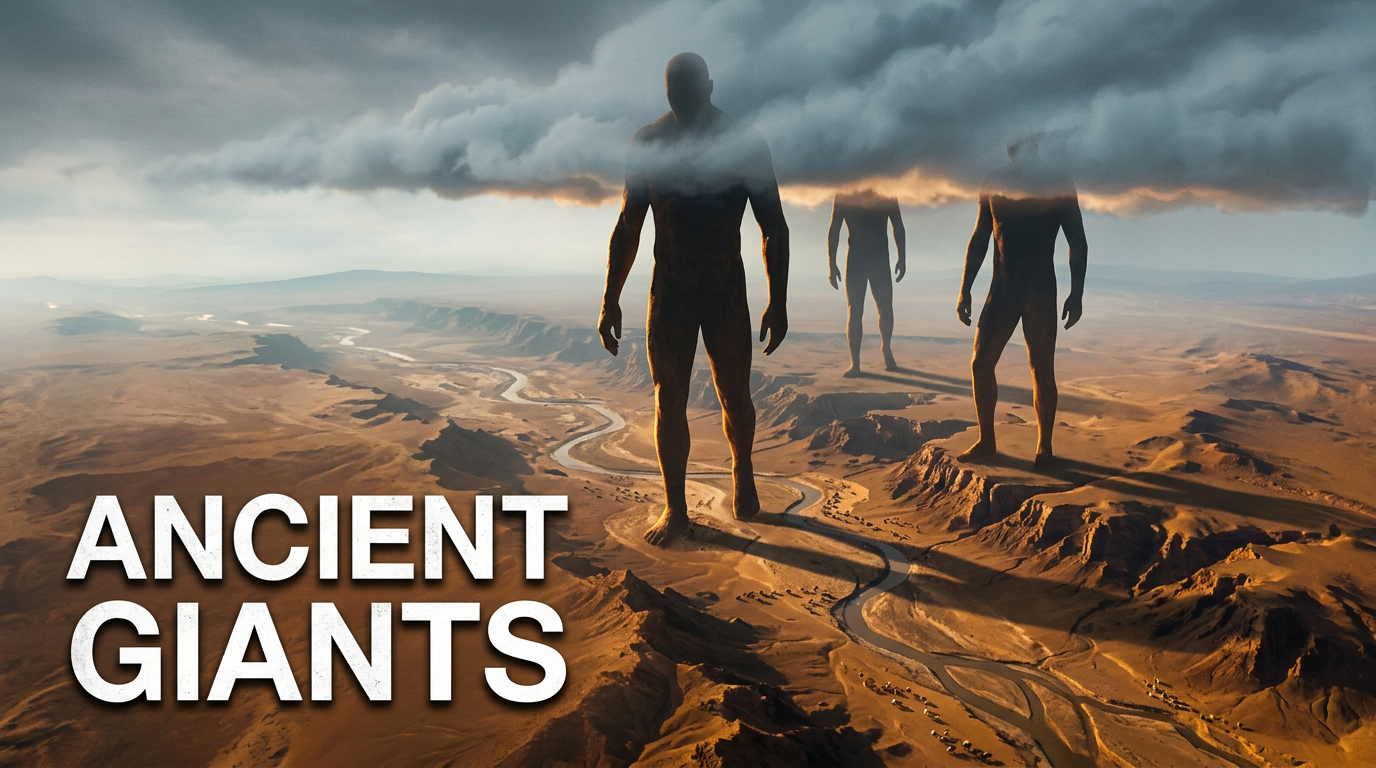
The 4,000 Cubits: The Giants Who Reached the Clouds episode of Midnight Signals begins with a discovery that changed the landscape of biblical scholarship and ends with a question geology has never officially been asked to answer. In 1947, a teenage shepherd stumbled into a cave above the Dead Sea and found sealed clay jars containing scrolls that had not been touched in two thousand years. Among the 900-plus manuscripts recovered from those eleven caves was a text that institutional religion had quietly walked away from: the Book of Giants. This post follows the evidence from the Judean desert to the mountain ranges of North America and Russia, and asks whether the beings described in that text left behind more than just a story.
Key Takeaways
-
The Book of Giants, recovered as part of the Dead Sea Scrolls, describes Nephilim offspring measuring 4,000 cubits tall, approximately 6,000 to 6,900 feet, and names them as specific individuals, including a figure identified as Gilgamesh.
-
Pre-Flood atmospheric theory holds that a dense water-canopy and significantly higher oxygen levels would have made extreme gigantism biologically viable in a way that is impossible under today's conditions.
-
Rapid burial under catastrophic flood pressure, combined with the process of silicification, could have transformed organic tissue of this scale into solid stone, not fossil bone, but entire geological formations.
-
Certain formations in the Appalachian Mountains and the Ural range display characteristics that this line of inquiry argues are consistent with mineralized biological remains rather than conventional geological uplift.
-
The Book of Giants was not lost by accident. It was deliberately excluded from canonical scripture, and the episode examines what motivated that exclusion.
The Discovery at Qumran and the Book of Giants
The Dead Sea Scrolls weren't discovered by archaeologists. They were found by a Bedouin shepherd boy who climbed into a cave looking for a lost goat and threw a rock into the dark. The sound of breaking clay changed the history of ancient religious scholarship. What followed was a decades-long excavation of eleven caves near Qumran, yielding 900-plus manuscripts ranging from biblical texts to community rules to works that had no place in any recognized canon.
The Book of Giants was among the latter. It extends the brief, unsettling mention of the Nephilim in Genesis 6 into a full narrative. It names individual giants: Oya, Hahya, and Mahua, the sons of Shemihaza, and notably Gilgamesh, a figure previously known exclusively from Mesopotamian epic tradition. The presence of Gilgamesh in a Jewish desert text is not a footnote. It is a data point suggesting that the ancient Near East shared a coherent collective memory of these beings, one that crossed cultural and geographic boundaries before institutional religion drew its lines.
The Math: What 4,000 Cubits Actually Means
The cubit is an ancient unit of measurement based on the length of a forearm, roughly 18 to 20.6 inches depending on the civilization using it. Four thousand cubits, by conservative calculation, works out to approximately 6,000 feet. By the upper bound, closer to 6,900.
That is taller than most mountains in the eastern United States. It is, by any modern biological standard, an extraordinary claim. And that's exactly what the episode interrogates: were the writers of the Book of Giants recording a biological reality, or manufacturing a metaphor? The case for the former rests on two pillars. First, the text treats the giants as individuals with names, personalities, dreams, and grief, not as mythological archetypes. Second, and more provocatively, there is the question of what environment would have to exist to make such a size biologically possible.
A Pre-Flood World Built for Giants
The answer proposed in this episode involves atmospheric physics. The pre-Flood world, according to certain theological and scientific models, existed under a dense water-canopy, a layer of water vapor suspended in the upper atmosphere that would have dramatically increased surface atmospheric pressure and oxygen concentration. Under such conditions, the biological rules that govern maximum size in living organisms would shift significantly.
We already know that oxygen availability is a primary constraint on biological scale. The Carboniferous period, when atmospheric oxygen was roughly 35% compared to today's 21%, produced insects with two-foot wingspans and other organisms scaled well beyond their modern equivalents. The same logic applied to a pre-Flood atmosphere of dramatically higher pressure and oxygen density suggests the upper ceiling for biological size was substantially higher than anything we observe today. It doesn't prove 4,000-cubit beings. But it removes the reflexive impossibility argument and replaces it with a question about degree.
Petrification: When Giants Become Mountains
If beings of this scale existed and were killed by a catastrophic global flood, the follow-up question is straightforward: where are the remains? The episode proposes a specific geological mechanism as the answer.
Under conditions of rapid, high-pressure burial, which is exactly what a global flood catastrophe would produce, organic tissue does not decompose through normal biological processes. Instead, it undergoes silicification. Mineral-rich water saturates the tissue, and silica molecules replace organic compounds one by one, transforming soft tissue into solid stone. This process is documented in smaller organisms and is responsible for much of the fossil record. Applied to organisms thousands of feet tall, buried instantly under immense pressure, the result would not be fossil bones in a museum case. It would be rock formations of biological origin, indistinguishable at the scale of a mountain range from normal geological uplift.
The episode examines specific formations in the Appalachian Mountains and the Ural range of Russia as candidate sites. The argument is not that these entire ranges are giants. It's that certain specific formation characteristics read differently when the biological-remains hypothesis is on the table. What conventional geology reads as the result of tectonic pressure and erosion, this line of inquiry reads as the silicified contours of beings that were, once, alive.
Frequently Asked Questions
What is the Book of Giants and why isn't it in the Bible?
The Book of Giants is an ancient Jewish text that expands on the Genesis 6 account of the Nephilim. It was among the Dead Sea Scrolls discovered in 1947 but was excluded from both the Hebrew Bible and the Christian canon. The episode argues this exclusion was deliberate. The contents were considered too disruptive to the accepted historical and theological framework to include in mainstream scripture.
Who were the Nephilim?
The Nephilim are described in Genesis 6 as the offspring of the "sons of God" and human women, hybrid beings of immense size and power. The Book of Enoch and the Book of Giants identify the "sons of God" as the Watchers, a class of angelic beings, and name specific Nephilim offspring individually.
How tall is 4,000 cubits?
Depending on the cubit measurement used, 18 to 20.6 inches, 4,000 cubits converts to approximately 6,000 to 6,900 feet tall. That is taller than most mountains in the eastern United States. The episode takes the position that the writers intended this as a literal biological measurement, not poetic exaggeration.
Could biological organisms that large actually exist?
Under today's atmospheric conditions, no. But the episode presents the pre-Flood atmospheric theory, a dense water-canopy increasing surface pressure and oxygen levels dramatically, as the environmental context that would shift the biological ceiling for maximum organism size. Higher oxygen concentration is already documented to produce larger organisms in the fossil record.
What is silicification and how does it relate to the giants?
Silicification is the process by which mineral-rich water replaces organic tissue with silica molecules, turning biological material into stone. It is a documented geological phenomenon responsible for petrified wood and other fossils. The episode applies this process at massive scale: if giants thousands of feet tall were buried rapidly under flood pressure, silicification would transform them not into identifiable bones but into rock formations, potentially entire sections of mountain ranges.
Which mountain ranges does the episode suggest could be fossilized giant remains?
The episode specifically examines formations in the Appalachian Mountains and the Ural Mountains in Russia as sites where the giant-remains theory is geologically arguable. The claim is not that these entire ranges are giants, but that certain specific formations within them display characteristics consistent with mineralized biological remains rather than purely geological origin.
Why was the Book of Giants excluded from scripture?
The episode explores this directly. Its contents, named giant individuals, the inclusion of Gilgamesh, and a detailed account of a pre-Flood world populated by beings that dwarf anything in recorded history, posed a direct challenge to the historical framework that religious authorities needed to maintain. Leaving it in the canon would have required answers that didn't exist yet.
Related Episode: 4,000 Cubits: The Giants Who Reached the Clouds


