Homer's Real Map: Viewing Greek Mythology Through the Book of Enoch
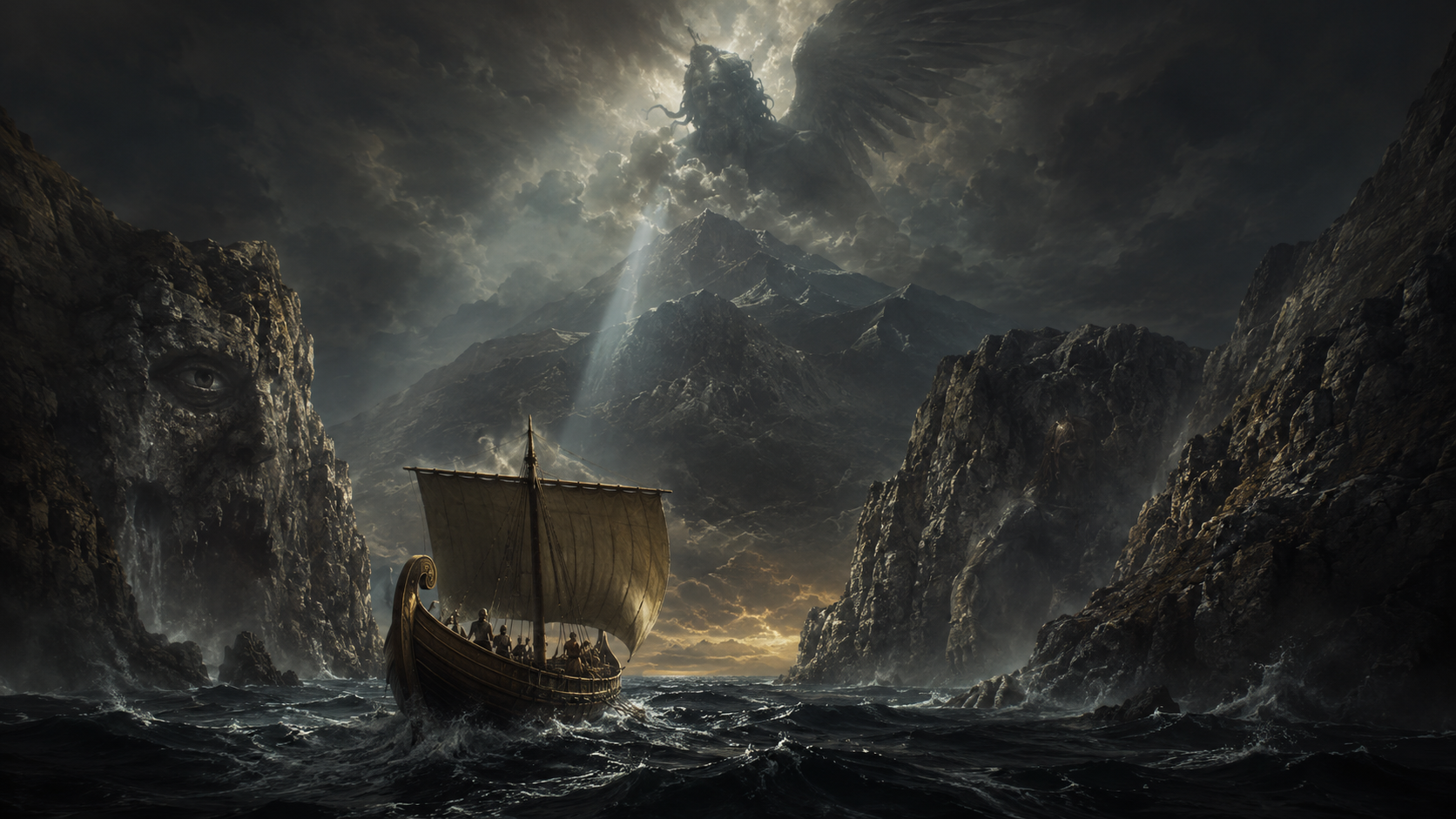
Welcome back, listeners and readers, to another deep dive into the hidden layers of ancient history, mythology, and the texts that mainstream academia prefers to keep locked away in the dusty archives of forbidden knowledge. Today, we are expanding on a conversation that blew open the phone lines on our most recent podcast episode. We are talking about Homer, the Odyssey, Mount Olympus, and a completely radical paradigm shift in how we view classical Greek literature. What if the towering epics of ancient Greece are not just imaginative poetry, the flights of fancy of a blind bard singing tales around a campfire? What if they are something far more concrete, far more unsettling, and entirely historical?
To pull off this perspective-shifting journey, we are going to use a very specific lens: the Book of Enoch. By cross-referencing the Greek pantheon and the monstrous adversaries of Odysseus with the Semitic cosmology found in Enochian literature, a startling picture emerges. We begin to see the gods of Mount Olympus and the terrors of the Mediterranean not as personified forces of nature, but as real, historical entities—specifically, fallen angels and their monstrous, hybrid offspring known as the Nephilim. Let us unpack the outline and explore Homer's real map.
Beyond the Myth of Mount Olympus
For centuries, Western education has trained us to neatly categorize ancient texts. The Hebrew scriptures, and associated texts like the Book of Enoch, are taught as theology, religious mythology, or apocalyptic literature. Conversely, the works of Homer—the Iliad and the Odyssey—are taught as secular literature, heroic poetry, and foundational mythology. We are told that Zeus, Apollo, Athena, Polyphemus, and Circe are the creative products of the ancient Hellenic imagination, invented to explain the rising of the sun, the roaring of the sea, and the unpredictable nature of human fate.
But what if this modern departmentalization is a clever, historical sleight of hand? What if the ancient Greeks were actually singing songs about the very same entities that the ancient Hebrews wrote about with trembling fear? When you strip away the romanticized marble statues and the sanitized Hollywood adaptations, the attributes of the Greek gods and the biblical descriptions of pre-Flood rebels start to look identical.
In our recent podcast episode, we discussed how the ancient world was far more interconnected than we are often led to believe. Trade routes, migrations, and oral histories meant that stories crossed cultural boundaries with ease. The names changed, the languages shifted, but the core entities remained the same. Today, we are going to trace those entities from the pages of Homer straight back to the ancient Semitic accounts of rebellion in the heavens. Grab your coffee, settle in, and let us decode the ancient world together.
Decoding Homer Through Ancient Semitic Texts
To successfully view Homer through the Book of Enoch, we first have to understand the foundational premise of Enochian cosmology. The Book of Enoch, though excluded from the standard Protestant canon, was widely read, accepted, and quoted by early church fathers and ancient Jewish communities alike. It provides a detailed, granular account of Genesis chapter 6: the descent of the Watchers.
According to Enoch, a cohort of angelic beings—referred to as Watchers—looked down upon the daughters of men, lusted after them, and made a pact to leave their heavenly habitation. Descending upon Mount Hermon, these entities intermarried with humanity, corrupting the human gene pool and introducing forbidden celestial technologies, weaponry, cosmetics, and sorcery to mankind. The offspring of this illicit union were the Nephilim—giants of immense stature, ferocious appetites, and immense violence who ultimately wreaked havoc on the earth, leading to the cataclysmic judgment of the global Flood.
Now, let us transport this narrative across the Aegean Sea. How did the Greeks remember this exact sequence of events? They didn't call them Watchers; they called them the Titans and the Olympians. They didn't call the cataclysm a global flood; they called it the deluge of Deucalion. But the core narrative arc is shockingly parallel: immortal beings descending from the sky, establishing kingdoms on earthly mountains, intermingling with mortals, producing superhuman offspring, and ruling over a golden age of tyranny and wonder.
When we read Homer with this Enochian framework, the epics transform. The interactions between gods and mortals on the plains of Troy are no longer mere literary metaphors for human psychology. They are historical echoes of real encounters between humans and supernatural, post-diluvian entities who were trying to re-establish their dominion over the earth after the waters of the Flood receded.
The Olympian Pantheon as Pre-Flood Watchers
Let us look closer at the roster of Mount Olympus. Mainstream mythology teaches us that Zeus is the king of the gods, the master of thunder and lightning, sitting upon his heavenly throne. Hera is his queen, Poseidon rules the oceans, and Hades governs the underworld. But if we map these characters onto the hierarchy of the Watchers outlined in Enoch, the similarities are staggering.
In the Book of Enoch, the leaders of the rebellious angels—figures like Azazel, Semyaza, and others—assigned specific functions and corruptions to mankind. They taught men how to forge swords, how to use roots for pharmacy and sorcery, and how to read the stars for divination. In Greek mythology, Prometheus brings fire against the will of Zeus, while various Olympians patronize specific crafts, war arts, and hidden knowledge.
Zeus himself mirrors the archetype of the supreme rebel leader. He overthrows his father, Kronos, in a cosmic coup—an event that directly parallels the heavenly rebellion in Semitic texts where a faction of divine beings usurps the rightful order. Zeus is depicted as notoriously licentious, constantly descending to earth in various disguises (shapes and forms) to cohabit with mortal women. Does this not sound precisely like the Watchers who "saw the daughters of men that they were fair; and they took them wives of all which they chose"?
Furthermore, consider the dwelling place of these entities. Mount Olympus in Greece is treated as a physical mountain, yet it is often shrouded in impenetrable clouds where mortals cannot easily tread. Similarly, in the Book of Enoch, the Watchers make a covenant upon Mount Hermon, swearing an oath to rebel against the Most High. Mountains in the ancient world were universally viewed as the natural boundary layers between the divine realm and the earthly realm. The Olympian pantheon represents the localized survival and cultural memory of these rebel entities, rebranded by the Hellenic poets as charismatic, flawed, yet undeniably powerful deities.
Monsters of the Odyssey and the Nephilim Legacy
If the Olympian gods are the disguised Watchers, what are the bizarre, terrifying creatures that Odysseus encounters on his legendary ten-year voyage home? This is where the plot thickens and where the Enochian connection becomes undeniable.
As we discussed on the podcast, the Book of Enoch explains that the destruction of the physical bodies of the Nephilim during the Flood did not solve the entire problem of their existence. Because they were hybrids—part heavenly spirit, part earthly flesh—their deaths released disembodied spirits that wander the earth as malicious entities. These are the unclean spirits or demons of biblical literature. But in the immediate post-Flood eras, and even lingering in pockets of the ancient world during the heroic age, literal physical giants and hybrid anomalies still walked the earth.
Let us examine Polyphemus, the Cyclops whom Odysseus encounters in the ninth book of the Odyssey. Polyphemus is a giant, single-eyed humanoid who lives outside the bounds of civilized law, practices cannibalism, and is the son of Poseidon, a primordial sea god. In the Enochian framework, Poseidon is essentially a marine-aligned Watcher or a powerful regional entity, and the Cyclopes are classic examples of Nephilim stock—aberrant, gigantic offspring possessing disproportionate physical strength and distorted anatomy.
Then we have the Laestrygonians, a tribe of giant cannibals who hurl massive boulders down upon Odysseus’s fleet, sinking ships as if they were toys. We have Scylla and Charybdis, monstrous entities guarding narrow straits, evoking the terrifying sea-monsters born from the genetic and spiritual corruption of the antediluvian world. Even Circe and the Sirens—figures who use enchanting songs, mind-altering potions, and sorcery to transform men into beasts—directly reflect the forbidden arts taught to mankind by Azazel and the Watchers, specifically the perversion of nature and the entrapment of human souls.
When Odysseus sails through the Mediterranean, he is not merely navigating a map of real Greek islands. He is navigating a supernatural obstacle course, charting the remaining pockets of pre-Flood contamination that survived the cataclysm and re-emerged in the strategic coastal regions of the ancient world.
Reinterpreting Classical Epic as Historiography
This brings us to a crucial question: Why should we care about shifting our view of Homer from poetry to historiography? What changes if we accept that the Iliad and the Odyssey are historical records of real entities?
The shift is monumental. For generations, modern secularism has taught us to dismiss ancient texts that speak of gods, giants, and miracles as primitive superstition. By doing so, we have blinded ourselves to the actual history of our planet. The ancients were not stupid; they were eyewitnesses—or the immediate descendants of eyewitnesses—to a world vastly different from our own. When Homer sings about heroes fighting alongside gods, and kings who trace their lineages back to divine ancestors, he is recording actual dynastic claims.
In the ancient Near East and the Mediterranean, royal bloodlines were obsessed with divine descent. Pharaohs, kings of Babylon, and the ruling houses of Mycenae and Greece all claimed to be *demigods*—the literal offspring of gods and mortals. In our modern cynicism, we write this off as royal propaganda. But if we take the Book of Enoch seriously, these royal houses were preserving the genetic and spiritual legacy of the Nephilim and the Watchers. They were boasting of their hybrid ancestry.
Reinterpreting Homer as historiography bridges the gap between biblical archaeology and classical studies. It shows us that the traditions found in Genesis and Enoch are not isolated tales told by a single desert tribe in the Levant. They are part of a global human memory of celestial intrusion, genetic corruption, and cataclysmic judgment. Every culture on earth remembers the time when the sky-beings came down and messed with humanity. Homer is simply the Greek voice of that universal trauma.
A New Lens on Ancient Mythology
As we wrap up this blog post and reflect on the themes of our latest podcast episode, I want to challenge you to look at your bookshelf—and the history of our world—with fresh eyes. The next time you pick up a translation of the Odyssey, do not read it as a comforting bedtime story about a clever king trying to get home to his wife. Read it as a survival manual.
Read it as a historical document detailing a world still reeling from a cosmic rebellion, haunted by the lingering specters of giantism and genetic chaos, and governed by entities who masqueraded as benevolent patrons while actually seeking the enslavement of mankind. The map that Homer draws is real. It is a map of a spiritual and physical war zone.
Thank you for reading, and thank you for listening to the podcast. If this post challenged your assumptions, share it with a friend, drop a comment below with your thoughts, and make sure you are subscribed to the show so you never miss an episode as we continue to unearth the hidden history of the ancient world.


