The Great Flood: A Cosmic Reset for Earth's Genetic Code
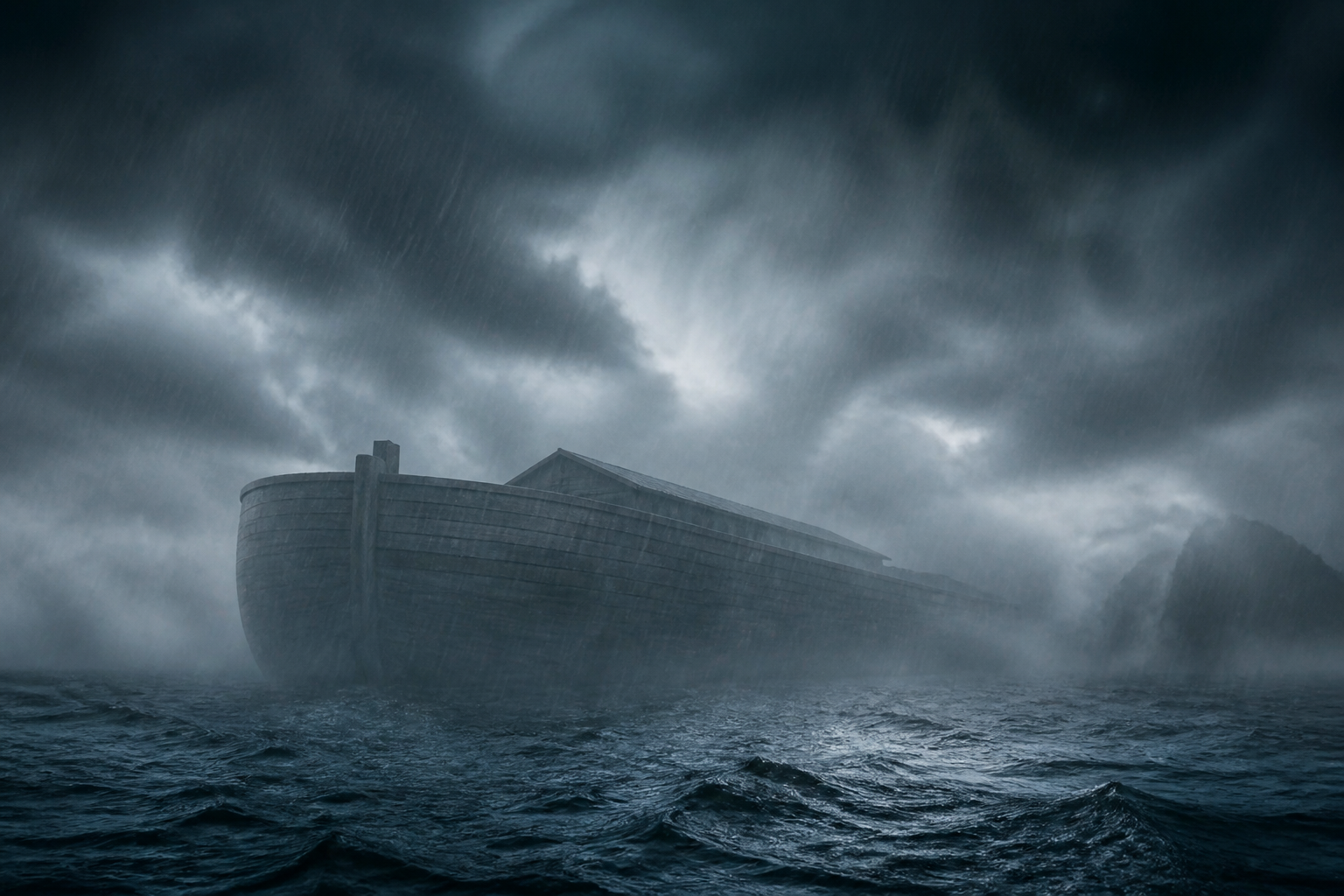
Some readings of ancient flood traditions go beyond moral judgment and ask whether the story also preserves a memory of biological corruption. In that interpretation, the Great Flood becomes not only a catastrophe, but a reset intended to preserve what remained uncorrupted. This article explores that theory through the Book of Enoch, the Book of Jasher, and the biblical Ark narrative.
Key Takeaways
- Enochic and related traditions describe forbidden interference with humanity and, in some interpretations, the natural order itself.
- Some readers connect those traditions with accounts of hybrid beings and biological corruption before the Flood.
- The genetic-reset interpretation views the Flood as a cleansing event rather than solely as punishment.
- Within that framework, Noah's Ark can be understood symbolically as preserving uncorrupted lineages of life.
- This remains a theological and alternative-history interpretation, not an established scientific account of genetics or the Flood.
The Biological-Corruption Theory
The Book of Enoch describes the Watchers crossing a forbidden boundary with humanity and producing the Nephilim. It also portrays them as teachers of knowledge that should not have been given. Other ancient and later texts have been read by some researchers as expanding that corruption beyond human society into the natural world.
The Book of Jasher is frequently cited in this discussion because certain passages have been interpreted as describing the mixing of different kinds of creatures. Proponents of the theory read this language as evidence of deliberate hybridization. Others understand it as legendary or theological storytelling rather than a record of biological engineering.
Either way, the interpretive idea is powerful: the pre-Flood world was not merely violent, but disordered at a fundamental level. Under that reading, the Nephilim become the most visible sign of a deeper corruption involving boundaries that were never meant to be crossed.
The Flood as a Reset
Within this framework, the Great Flood is reinterpreted as a drastic intervention designed to end that corruption and preserve a viable remnant of creation. The argument does not come from modern genetics in the scientific sense. It comes from reading ancient ideas of purity, kinds, lineage, and corruption through a modern biological metaphor.
That distinction matters. Saying the Ark functioned like a "gene bank" is a useful analogy for the theory, not a literal description found in Genesis. Proponents use the image to explain why the story places such emphasis on preserving pairs of living creatures and on Noah's family surviving as the human remnant.
Noah's Ark as a Preservation Vessel
The biblical account presents the Ark as the means by which human and animal life survives the catastrophe. Readers who favor the corruption theory see this as a selective preservation event: what passes through the Flood becomes the foundation of the world that follows.
Some extend that idea to the description of Noah as "perfect in his generations," interpreting the phrase as a reference to lineage or biological integrity. Other scholars understand the wording morally or genealogically rather than genetically. The text itself leaves room for debate, which is why the phrase has become central to this interpretation.
Did Corruption Survive?
A further complication is that giant traditions continue after the Flood in biblical and extra-biblical literature. That has led to several competing explanations among believers: remnants survived, the corruption reappeared, later giant clans had a different origin, or the traditions preserve separate legendary memories.
The genetic-reset model does not settle that question. Instead, it highlights the tension between a supposedly cleansing Flood and the later reappearance of beings associated with the old world.
Why the Theory Endures
The idea of the Flood as a biological reset remains compelling because it links several ancient themes that are usually discussed separately: the Watchers, the Nephilim, forbidden knowledge, the corruption of creation, Noah's lineage, and the preservation of living kinds.
Whether those themes describe literal biological events, theological symbolism, or some mixture of memory and myth is unresolved. The value of the theory is not that it proves a hidden genetic history, but that it provides a coherent lens through which these ancient texts can be read together without pretending the interpretation is settled fact.
For the full Midnight Signals exploration, listen to The Creature Noah Was Told to Leave Behind.
Frequently Asked Questions
Was the Great Flood literally a genetic reset?
That is an interpretive theory, not an established scientific conclusion. It reads ancient themes of corruption, purity, and preservation through a biological lens.
Do ancient texts describe hybrid creatures?
The Book of Enoch clearly describes hybrid offspring in the Nephilim tradition. Other texts are sometimes interpreted as describing broader mixing of kinds, though those readings are debated.
Was Noah chosen because of genetic purity?
Some readers interpret the phrase "perfect in his generations" that way. Others understand it as moral or genealogical language. The text does not settle the modern genetic interpretation.
The Mad Gasser of Mattoon: When a Town Turned Fear Into a Villain