Ancient Antarctic Maps Hint at Lost Ice-Free Civilization and Hidden History
Explore how historical maps challenge our understanding of Antarctica, revealing a potentially ice-free continent and suggesting a forgotten civilization predating modern history. Discover the implications of these cartographic anomalies and the persistent theories about what Antarctica's past might truly hold.
Key Takeaways
- Ancient maps like the Piri Reis and Orontius Finaeus depict Antarctica without ice, featuring detailed coastlines and geographical features that align with modern subglacial surveys.
- These maps suggest a sophisticated understanding of Antarctica existed thousands of years ago, possibly during a brief warm period around 12,000 years ago.
- The existence of such accurate ancient charts fuels theories of an advanced, prehistoric civilization that possessed advanced mapping and astronomical knowledge.
- The discrepancies between these ancient maps and the current icy landscape raise profound questions about lost history and potential cover-ups regarding Antarctica's true past.
- The strict international control and secrecy surrounding Antarctica may be an effort to hide evidence of this ancient civilization or the cataclysm that led to its demise.
Ancient Maps Challenging Modern Geography
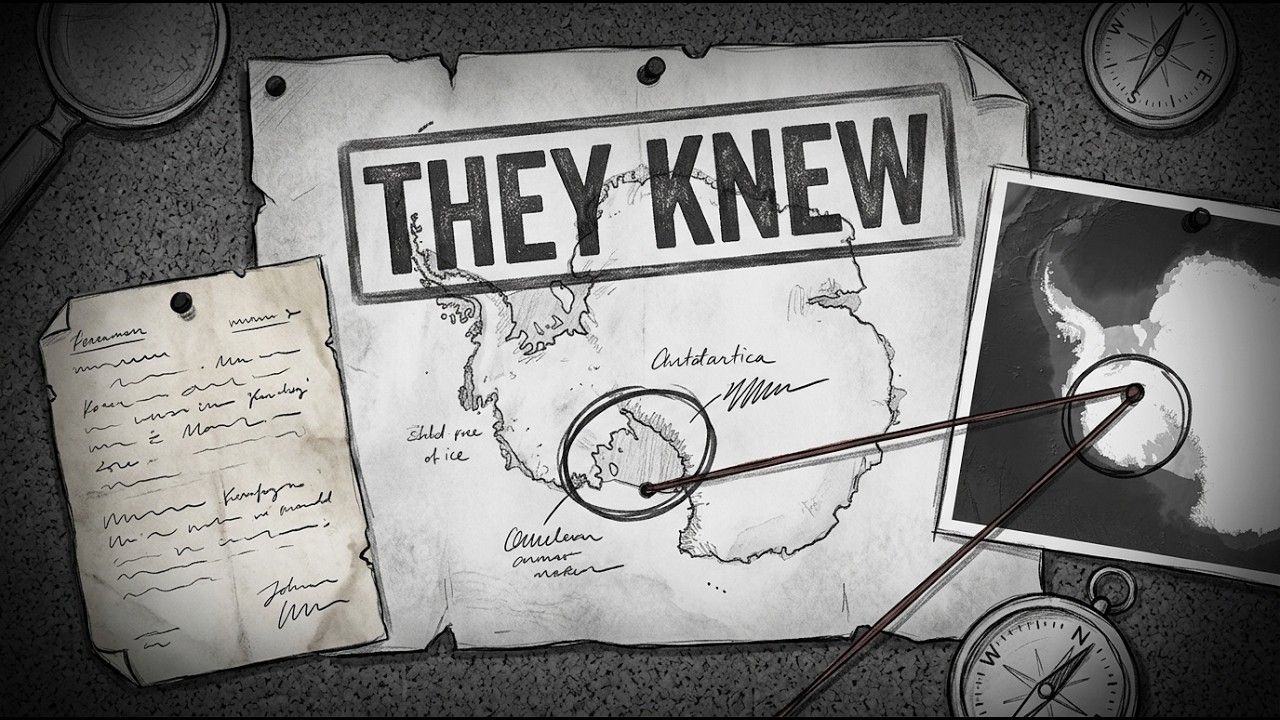
For centuries, cartography has been our guide to understanding the world. Yet, some of the oldest maps we possess offer a version of Antarctica that is radically different from the frozen wasteland we know today. Maps such as the Piri Reis map from 1513, the Orontius Finaeus map from 1531, and the Urbano Monte map from 1587 all depict Antarctica not as a continent of ice, but as a landmass with detailed coastlines, rivers, and even mountain ranges, entirely free of ice.
What is particularly astonishing is how these ancient charts seem to correlate with modern geographical discoveries made beneath the ice. Seismic surveys and radar technology have revealed subglacial rivers, lakes, and mountain ranges that mirror the features depicted on these centuries-old maps. The Piri Reis map, for instance, shows a coastline that aligns remarkably well with the topography of Queen Maud Land, a region now buried under miles of ice. The Orontius Finaeus map presents an equally detailed, ice-free Antarctica, complete with a central mountain range and river systems.
This uncanny accuracy, especially when considering the cartographic tools and scientific understanding of the eras in which these maps were created, suggests a source of information far beyond conventional historical accounts. It implies that a sophisticated civilization, existing long before recorded history, possessed the knowledge and capability to map the entire Antarctic continent with surprising precision.
The Ice Age Civilization Theory
The implications of these ancient, ice-free maps are profound, leading to compelling theories about a lost chapter of human history. The most prominent theory posits the existence of an advanced civilization during a period when Antarctica was not covered in ice. Geological evidence suggests that Earth experienced a brief warming period around 12,000 years ago, at the end of the last Ice Age. It is during this window, proponents argue, that an advanced culture might have thrived on what was then a habitable continent.
This theory suggests that this civilization achieved a level of technological and societal development that allowed for sophisticated astronomical observation and, consequently, detailed cartography. They would have had the means to accurately chart the globe, including the southern continent. The subsequent rapid glaciation of Antarctica, possibly triggered by a cataclysmic event, would have led to the demise or displacement of this civilization, and their knowledge would have been lost to time, preserved only in these enigmatic maps.
The existence of such a civilization challenges our current understanding of human history, which typically places the dawn of advanced societies much later. If true, it means that humanity has experienced cycles of advancement and collapse, with vast periods of history being erased or forgotten. The maps, in this context, are not merely geographical records but echoes of a forgotten past, hinting at a world that existed before the great ice age.
Secrets Beneath the Ice and the Treaty
The enigma deepens when considering the modern-day context of Antarctica. The Antarctic Treaty, signed by 54 nations, ostensibly serves to protect the continent for scientific research and peaceful purposes. However, its stringent regulations and the significant military presence surrounding the continent raise questions about its true purpose. Independent researchers and civilian flights are often denied access or intercepted, creating an atmosphere of tightly controlled secrecy.
Beneath the ice, scientific exploration has uncovered anomalies that further fuel speculation. Lake Vostok, a vast liquid body of water hidden beneath miles of ice, harbors unique microbial life with unknown taxonomy. Seismic surveys have detected extensive tunnel systems and geometric patterns on the subglacial landscape that defy natural explanations. Some researchers even propose that parts of Antarctica might be an artificial structure, perhaps built by a pre-flood civilization for purposes we can only guess at.
The intense secrecy surrounding Antarctica, coupled with the discovery of these subglacial anomalies and the evidence of an ice-free past suggested by ancient maps, leads to a compelling question: What is being hidden? Is it the remnants of a lost civilization, evidence of advanced prehistoric technology, or perhaps something even more extraordinary that would fundamentally alter our understanding of Earth's history and its inhabitants?
Why This Matters
The potential existence of an advanced Ice Age civilization and the hidden history of Antarctica are not just fringe conspiracy theories; they are questions that arise from tangible evidence in ancient cartography and modern scientific discovery. The ancient maps offer a tantalizing glimpse into a past that contradicts established timelines of human development. If these maps are accurate, they suggest that a civilization with sophisticated knowledge existed thousands of years before the Sumerians or Egyptians, potentially rewriting the entire narrative of human civilization.
The implications extend beyond historical curiosity. Understanding what might lie beneath the Antarctic ice or what secrets the continent holds could shed light on our planet's past climatic cycles, potential lost technologies, or even the true origins of humanity. The continued secrecy and restricted access to Antarctica only serve to amplify these questions, suggesting that the official narrative may be incomplete, or worse, deliberately misleading. It forces us to consider that our modern understanding of history might be based on a carefully curated version of events, with significant portions of our planet's past intentionally obscured.
Exploring these theories challenges us to think critically about accepted historical paradigms and to consider the possibility that much of our planet's true history remains undiscovered, locked away beneath miles of ice or hidden behind a veil of international policy. The ancient maps are more than just curiosities; they are potential keys to unlocking a forgotten epoch of human ingenuity and a lost world that once thrived where now only ice reigns.
For a deeper dive into the mysteries of Antarctica, the forbidden maps, and the secrets they might hold, Listen to the full episode of Midnight Signals.
Frequently Asked Questions
What makes the Piri Reis map significant regarding Antarctica?
The Piri Reis map is significant because it accurately depicts the coastline of Antarctica, including details like river systems, without ice, despite being created in 1513. This level of detail aligns with subglacial mapping, suggesting it was based on much older, unknown sources.
When could Antarctica have possibly been ice-free?
Geological evidence suggests a brief warming period around 12,000 years ago, at the end of the last Ice Age, might have allowed Antarctica to be ice-free and habitable, aligning with theories of advanced ancient civilizations mapping the continent during that time.
Why is there such strict secrecy around Antarctica today?
The exact reasons for the secrecy are debated, but theories range from hiding evidence of a lost advanced civilization, protecting unusual subglacial discoveries, to concealing advanced technologies or phenomena that contradict our current scientific understanding. The Antarctic Treaty, while seemingly for preservation, enforces strict control over exploration.
What is the theory about Antarctica being an artificial structure?
Some researchers propose that parts of Antarctica, or the entire continent, might be an artificial construct built by an ancient civilization. This idea is partly fueled by unexplained geometric patterns detected beneath the ice and the desire to explain how such an advanced civilization could have mapped the continent so accurately.
What is suggested about German expeditions in Antarctica?
Prior to WWII, German expeditions like the New Swabia expedition reportedly mapped large areas of Antarctica, finding ice-free regions and warm lakes. This has led to theories about hidden German bases (like Base 211) and suggests they may have possessed knowledge of Antarctica's potential past or hidden features.