The Czech Castle Built To Cover Hell


Key Takeaways
- Huska Castle is a medieval fortress in the Czech forest north of Prague that was constructed with no water source, no strategic trade route to protect, and no surrounding village.
- Local legends describe the castle as being built directly over a bottomless fissure that allegedly swallowed stones silently and emitted terrifying, non-human creatures.
- According to folklore, King Otakar II offered a condemned prisoner a full pardon to descend into the pit, and the man was pulled up moments later looking thirty years older with snow-white hair and a shattered mind.
- To seal the opening, workers built a Gothic chapel dedicated to Saint Michael the Archangel directly over the fissure, featuring bizarre imagery like a left-handed centaur fresco.
- Over the centuries, the castle attracted dark figures like the occult-obsessed mercenary Oranto and was later seized by the Nazi SS to store confiscated manuscripts and potentially conduct secret experiments.
A medieval castle with no well, no village, and no strategic purpose should not exist, yet Huska Castle stands in the Czech forest north of Prague like someone put it there on purpose. We walk through the details that make the place feel wrong from the start: defenses that seem aimed inward, blocked openings that resemble windows, and a structure that looks less like a lookout and more like a clenched fist around the rock beneath it.
From there, we follow the Huska Castle legend that refuses to die, the “bottomless” fissure said to swallow stones without a sound and to repel animals as if the ground itself is warning them away. The story turns brutal when a condemned prisoner is lowered into the darkness for King Otakar II, only to return minutes later with white hair and a mind that cannot hold what he saw. The response is not exploration, but architecture: workers seal the opening and build a Gothic chapel directly over it, dedicated to Saint Michael the Archangel, the armed guardian against chaos.
We also dig into the chapel’s strangest clue, the left-handed centaur fresco that doesn’t belong among Christian scenes, and the persistent reports of a faceless black-robed monk standing watch nearby. As centuries pass, Huska gathers new layers of dread: rumors of the mercenary Oranto using the castle for black magic, Nazi seizure during World War II for storing confiscated manuscripts, and later whispers of occult experiments that never quite find proof. Modern paranormal investigators bring cameras and EMF sensors, then report the same old pattern in new language: failing equipment, oppressive heaviness, scratching under stone, and voices that seem to rise from below.
If you love haunted history, Czech folklore, and mysteries where records end and legends begin, press play, then subscribe, share the show, and leave a review so more listeners can find Midnight Signals.
Frequently Asked Questions
What is Huska Castle?
Huska Castle is a 13th-century Gothic fortress built north of Prague in the Czech Republic, famous for legends claiming it was constructed to seal a gateway to hell.
Why is Huska Castle considered unusual?
Unlike typical medieval strongholds, Huska Castle has no natural water source, no defensive walls facing outward, and no strategic proximity to trade routes or borders, as its defenses face inward toward its courtyard.
Who built Huska Castle and why?
Historically built as a royal administrative center for King Otakar II of Bohemia, legend states it was actually constructed as a stone lid to cover a bottomless fissure plagued by demonic creatures.
What is hidden inside the Huska Castle chapel?
The castle chapel is built directly over the alleged fissure and features an unusual left-handed centaur fresco alongside traditional Christian artwork depicting Saint Michael defeating the dragon.
00:00 - A Castle With No Purpose
02:48 - The Bottomless Fissure Legend
04:39 - The Prisoner Returns White Haired
06:28 - Building A Chapel To Seal It
09:08 - Centaur Fresco And Faceless Monk
10:11 - Oranto And Forbidden Experiments
11:49 - Nazis Seize Hauska For Secrets
13:59 - Paranormal Teams And Failing Equipment
16:54 - Final Warnings And Closing Words
A Castle With No Purpose
SPEAKER_00Sometime between 1253 and 1278, a castle was raised in the forest north of Prague where no castle should have been. It guarded no border, it overlooked no trade route. There was no village beneath its walls, no farmland to support a garrison, and no natural source of water inside. Even the hill offered little military advantage. There was only the rock. At the center of the site, directly beneath what would become the castle chapel, was a fissure in the limestone that local villagers believed had no bottom. They said stones vanished into it without making a sound. Animals refused to approach it, and after sunset, things that were neither human nor animal began crawling out of the darkness. On paper, Huska Castle was built to administer the royal estates of King Odokar II of Bohemia. According to the legend, it was a lid. Deep in the Kokoginsko forest, roughly 30 miles north of Prague, Huska rises from a sandstone outcrop surrounded by dense woodland and marshy ground. The trees press close around the castle, blocking the horizon and swallowing the sound of the outside world. From a distance, it resembles any other medieval stronghold. Its stone walls, towers, courtyard, and gothic chapel belong to the same world as hundreds of castles scattered across Central Europe. But Hooska was built differently. There was no spring or well inside the castle. Rainwater had to be collected in a cistern, which would have made surviving a siege nearly impossible. The castle stood far from the roads and rivers that carried armies, merchants, and royal messages through medieval Bohemia. There was no important settlement to protect, and no valuable path to control. Then there were the defenses. Openings that appeared to be windows ended against thick stone. Access between the courtyard and the upper floors was unusually restricted. Parts of the fortification seemed to focus inward toward the center of the castle, rather than outward toward an approaching enemy. Hauska did not feel like an eye watching the forest. It felt like a fist closing around something inside. The rock formation beneath the castle pierces directly through the structure. It can still be seen breaking through the courtyard and sections of the interior. The builders did not simply choose the outcrop as a foundation, they enclosed it. Most castles reveal their purpose immediately. They occupy borders, river crossings, trade routes, or commanding heights. Hauska fits the category of a royal administrative center in the historical record, but its location ignores nearly every practical advantage such a center should have possessed. Unless the location itself
The Bottomless Fissure Legend
SPEAKER_00was the reason it had to be built. People had lived in the region long before the first stone walls appeared. Celtic tribes passed through the area in antiquity, and Slavic settlers arrived centuries later. A wooden stronghold may have occupied the hill as early as the 9th century. In 1541, the Bohemian chronicler Vaslav Hayek preserved an older tradition about the site. According to the story, a fissure had opened in the rocky cliff. Villagers attempted to fill it with stones, but the darkness swallowed everything they threw inside. No impact could be heard. No matter how much material they dropped into the opening, the level never rose. The villagers began calling it bottomless. Then the reports grew worse. Animals refused to drink or graze near the outcrop. Birds would not land in the trees above it. Livestock disappeared from nearby settlements, leaving no tracks and no remains. At night, shapes emerged from the opening. Some witnesses describe creatures with the bodies of animals and the faces of men. Others reported dark forms with wings moving above the cliff. The descriptions changed from one telling to the next, but they shared one detail. Whatever came from the pit did not belong in the forest. People began avoiding the hill even during daylight. Hunters chose longer paths rather than pass beneath the cliff. Children were warned that if they played too close to the opening, something might follow them home. Some villagers feared more than an attack. They believed the pit could change anyone who remained near it for too long. A person might become sick, lose control of his mind, or slowly transform into the same kind of creature said to crawl from the opening. The pit was not merely dangerous, it was contagious.
The Prisoner Returns White Haired
SPEAKER_00According to the most famous version of the legend, word of the fissure eventually reached King Otakar II. The king needed to know what lay beneath the hill, but no soldier or servant would willingly enter it. So a pardon was offered to a prisoner already sentenced to death. If the man agreed to be lowered into the opening and report what he saw, he would be released. The prisoner was young and healthy. Faced with execution, he accepted without hesitation. A rope was tied around his body, and men gathered at the edge of the fissure to lower him into the dark. For the first few moments nothing happened. Then the screaming began. The men holding the rope said it was not the cry of someone who had slipped or struck the wall. It was the scream of a person who had seen something his mind could not survive. They pulled him back as quickly as they could. The man who emerged was not the same man they had lowered. His hair had turned completely white. Deep lines had appeared across his face, and his skin hung from his bones as though decades had passed beneath the ground. He shook uncontrollably and could no longer speak in complete sentences. Between fits of panic, he babbled about shapes moving in the darkness and things reaching for him from inside the rock. The prisoner had been below the surface for only a few minutes, but he appeared to have aged thirty years. The story says he was confined to an asylum and died shortly afterward, his mind destroyed by whatever he had witnessed. No one remembers his name. The legend remembers only what came back up. After that, no one else volunteered. The king had his answer. Whatever lay beneath the hill was not meant to be explored. It was meant to be sealed. Workers covered the opening with heavy stone and began constructing the castle around it. Directly
Building A Chapel To Seal It
SPEAKER_00above the fissure, they built a chapel dedicated to the archangel Michael. That choice may be the most revealing detail in the entire story. Michael was not a peaceful patron chosen to bless a noble residence. In Christian tradition, he is the commander of the heavenly host, the warrior who defeated the dragon and cast the rebellious angels out of heaven. He stands armed against the forces of darkness and guards the boundary between divine order and chaos. If medieval builders believed they were sealing a gateway into hell, Michael was the angel they would place over it. The chapel was not built beside the alleged opening. It was built directly on top of it. Every stone in its floor became another layer of the seal. Every prayer spoken inside became part of the defense. Every image painted across its walls reminded whatever waited below that an armed angel stood above the door. The chapel still contains faded Gothic frescoes depicting the crucifixion of Christ, the weighing of souls, and Saint Michael fighting the dragon. But one image does not belong to any familiar biblical scene. Painted among the Christian figures is a female centaur, a creature with the upper body of a woman and the lower body of a horse. She holds a bow in her left hand and appears ready to fire. The image has disturbed visitors for generations. A pagan hybrid inside a Christian chapel would already be unusual. A left-handed pagan creature inside a chapel dedicated to the angel who defeated Satan is even stranger. Medieval symbolism often connected the left side with disorder, deception, and damnation. The Latin word sinister originally meant left. The centaur may have been intended as a warning against temptation or pagan belief, but inside Hauska, directly above a pit said to release half human creatures, the image takes on another meaning. Perhaps the artist was not painting a symbol. Perhaps he was painting a witness. The creature resembles the same hybrids villagers claimed had emerged from the fissure. A human form joined to the body of an animal, armed and facing the interior of the chapel. If the fresco was meant to represent evil, why place it inside the seal? Unless the purpose was not to invite it in, but to record what was already below. The colors have faded, but the centaur remains on the wall. Saint Michael still faces the dragon. The two images occupy the same sacred space, as if the chapel preserves both sides of an ancient conflict. The guardian and the thing being guarded against. Hauska
Centaur Fresco And Faceless Monk
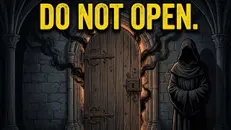
SPEAKER_00has another guardian as well. Visitors have reported seeing a black robed monk standing near the chapel. His hood hangs low, but there is no face inside it. He appears without warning and watches from the edge of the room. Some say he disappears the moment anyone approaches. Others claim he remains perfectly still until they look away. No one knows whether the monk is a human spirit, something that escaped from beneath the floor, or a sentinel placed there to make sure the seal remains unbroken. Perhaps he is not haunting the castle, perhaps he is still performing his duty. Over the centuries, Hauska passed through the hands of noble families who tried to turn the fortress into a home. During the 1580s, the Hurzan of Harasov family rebuilt portions of it in the Renaissance style. They added a new entrance wing, decorated the rooms, and transformed the stark medieval structure into something closer to a noble residence. For a time, the castle appeared to settle into normal life, but Hauska has never stayed normal for long.
Oranto And Forbidden Experiments
SPEAKER_00During the 17th century, the castle became associated with a Swedish mercenary known as Oranto. Local stories describe him as a practitioner of black magic who used the castle as a laboratory. Night after night, lights burned behind his windows until dawn. Villagers claimed they could hear chanting from inside the walls and see smoke rising from rooms where no fire should have been burning. Oranto was supposedly searching for an elixir that could grant eternal life. He collected strange texts, conducted experiments in isolation, and became increasingly obsessed with the power believed to exist beneath the chapel. To the villagers, he was not studying the castle. He was trying to wake it. Fear eventually overcame their reluctance to enter the grounds. Two local hunters broke into Hauska and killed Oranto inside his laboratory. The lights went out, but the castle's reputation remained. Oranto had treated the sealed pit as a source of power rather than a prison. If the legends are true, that may have been the mistake that killed him. By 1700, Hauska had fallen into severe disrepair. Sections of the roof collapsed, water entered the rooms, and vegetation crept across the courtyard. The building was restored during the 19th century and passed through several owners before Joseph Shimonek, the president of Skota Auto, purchased it in 1924. He had the resources to restore a castle that was too isolated to serve much practical purpose. But before his family could enjoy it for long, Europe descended into war.
Nazis Seize Hauska For Secrets
SPEAKER_00Following the German occupation of the Czech lands, Nazi forces seized Hauska Castle. The documented history is disturbing enough. From 1943 onward, the castle was used to store confiscated Jewish and Masonic books and manuscripts. Its remote location made it a convenient depository, hidden in the forest and far from the major cities being bombed. But the legend goes further. Heinrich Himmler and other senior members of the SS had a well-documented fascination with occult traditions, Germanic mythology, and objects they believed could support their vision of an ancient Aryan past. Himmler established the Annen Erba, an organization that sent researchers across Europe searching for archaeological and mythological evidence to legitimize Nazi ideology. A castle already believed to stand over a gateway to hell would have been difficult for men like that to ignore. Local stories claim the Nazis brought more than stolen books to Hauska. They speak of forbidden manuscripts, ritual objects, and ceremonies conducted inside the chapel after dark. People living near the forest reported strange lights moving through the upper windows. They heard rhythmic sounds coming from the castle at night and voices that seemed to rise from beneath the floor rather than from the rooms above it. Some versions of the story claim SS officers attempted to draw power from the sealed opening. Others say they wanted to communicate with whatever existed on the other side. No surviving document proves that such ceremonies occurred. The known records identify Hauska as a storage site, not an occult laboratory, yet the absence of records has never silenced the story. Another persistent account says that three German soldiers were found dead in the courtyard after the war. Their deaths were never clearly explained, and no one knew why their bodies had been left behind. The Nazis did not create Hauska's legend. They simply became another layer of it. After the war, the castle passed into state hands. It was eventually returned to the Schemanec family following the end of communist rule and opened to the public in 1999.
Paranormal Teams And Failing Equipment
SPEAKER_00By then, Hauska's reputation had spread far beyond the surrounding villages. Paranormal investigators arrived with cameras, audio recorders, thermal equipment, and electromagnetic sensors. Several television teams spent nights inside the castle, hoping modern instruments could detect what medieval villagers had only described. Investigators have reported sudden equipment failures, unexplained voices captured on recordings, and electromagnetic disturbances near the chapel floor. Batteries lose power without warning. Cameras stop recording. Signals weaken in rooms where there is no obvious source of interference. The equipment changes, the reports do not. The alleged pit beneath the chapel remains inaccessible. One explanation repeated for leaving the lower sections undisturbed is the possibility that wartime explosives or unexploded munitions remain hidden inside the structure. It is a practical explanation. It also ensures that the question cannot be settled. Investigators who claim to have lowered instruments near the sealed area say the readings fail before revealing a floor. The signal does not show the bottom, it simply disappears, just as the stones did in the original legend. Visitors describe an oppressive heaviness inside the chapel. Some feel it immediately upon crossing the doorway. Others experience nausea, dizziness, or the sudden conviction that they are being watched from beneath the floor. Scratching sounds have been reported under the stone. Not footsteps moving across the room, not branches scraping against an outside wall, slow, deliberate scratching from somewhere below. A few visitors claim to have heard screaming rise through the chapel floor. The sound begins faintly, almost too distant to recognize, then grows loud enough to make them leave the room. Old castles collect ghost stories as stone collects moss. Hauska has its wandering woman, its headless horse, and the shadowy figures seen moving through empty corridors. But the reports that define this place are not the ordinary ghosts of people who died there. They are the things that were never human. Witnesses have described dark-winged forms circling above the castle and vanishing into the trees. Others report a creature resembling a cross between a man and a bullfrog crawling through the lower corridors on limbs that bend in the wrong direction. It does not walk upright, it drags itself close to the floor, moving quickly from one patch of darkness to another. Then there is the faceless monk, still standing watch beside the chapel. These stories echo the oldest accounts of Hauska. The creatures change shape, but they always emerge from below. The witnesses change, but they always describe the same sensation. Something inside the castle is waiting to be released.
Final Warnings And Closing Words
SPEAKER_00The official explanation for Hauska is simple. It was a royal administrative center constructed during the reign of Audakar II. Perhaps that is true, but people do not remember Hauska as an office. They remember the missing well, the useless position, the strange interior defenses, the chapel of St. Michael, and the fissure hidden beneath its floor. Seven centuries have erased whatever ordinary function the castle once served. They have not erased the warning. What if the legend was not invented to explain the castle after it was built? What if the castle was built because the legend was already there? Maybe the villagers knew something about that hill that has been lost. Maybe the creatures were given different names as the story passed from one generation to the next. Demons, hybrids, winged beasts, shadows in the forest, or maybe the names changed because no one who saw them understood what they were looking at. Hauska Castle has survived wars, occupation, abandonment, and centuries of decay. Yet no invading army defines its history. No king made it famous by ruling from its halls. No great battle was fought beneath its walls. The castle is remembered because of what lies beneath it. The chapel still stands over the place where the fissure was said to open. Saint Michael still faces the dragon. The centaur still draws her bow with the wrong hand. And the black monk still appears beside the wall, watching a door no one else can see. The seal has held for more than 700 years. But seals are only stone. Stone shifts, stone cracks. And whatever frightened the people who built Hauska may have had centuries to wait. If you hear something scratching beneath the chapel floor, do not search for where it is coming from. If a scream rises through the stone, do not answer it. And if you see a faceless monk standing in the corner, walk away. He may not be there to keep you from entering. He may be there to stop something else from leaving. Some gates are built to open. Hauska was built to remain closed. This has been a broadcast by Midnight Signals. I'm Russ Chamberlain guiding you through the shadows where history meets mystery. Visit MidnightSignals.net to continue the conversation, explore more episodes, and say hello. If you enjoyed tonight's journey, please like, subscribe, and share to help more listeners find the show. Until next time, stay vigilant, seek the hidden, and remember in every silence there is a signal, and in every signal, a story waiting to be told.


