The Real Stranger Things: The Montauk Project Exposed
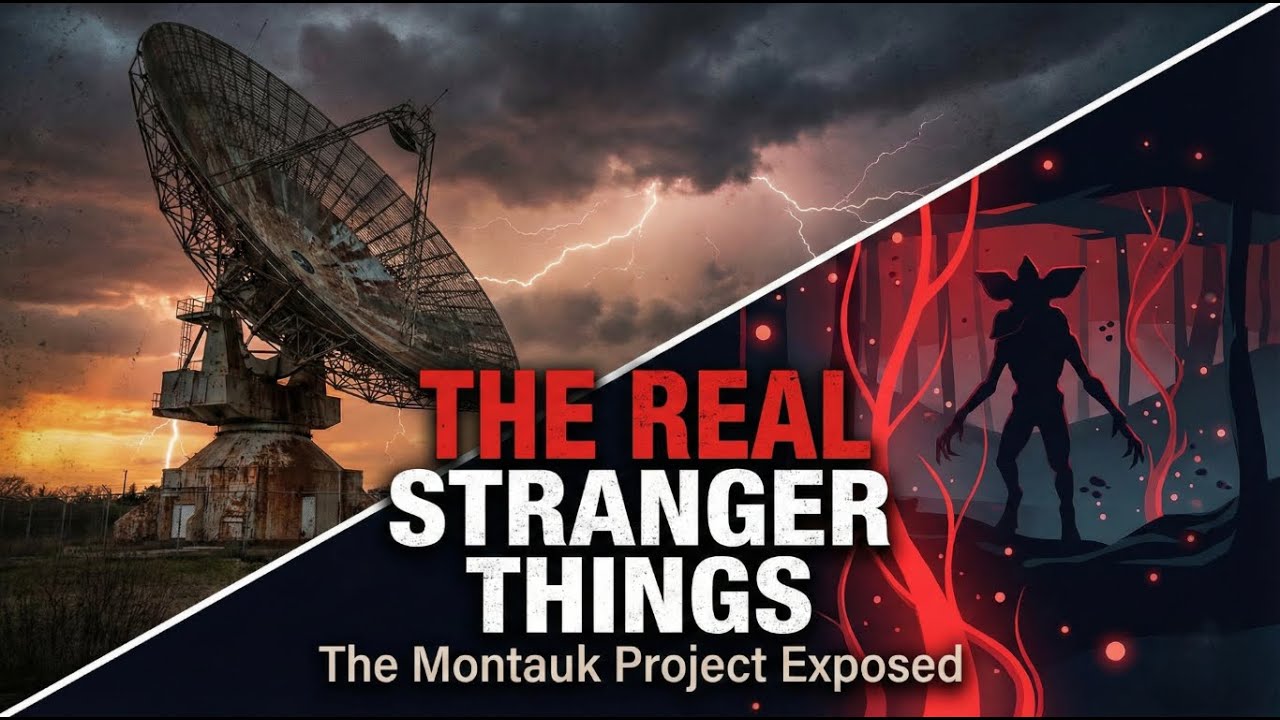


Camp Hero sits at the edge of Long Island like a closed book that never stopped humming. A Cold War radar tower. Concrete bunkers welded shut. And a legend that many believe helped inspire Stranger Things.
The story says the SAGE dish did more than scan the sky. It broadcast a signal that could press on the human mind, turning a quiet town anxious, sick, and wired with dread. Beneath the dunes, the rumors go deeper: hidden levels, impossible generators, and a device called the Montauk Chair, built to turn thought into transmission. Remote viewing becomes creation. Creation becomes a door. And on one night in August 1983, something comes through that door.
00:07 - The Pulse of Camp Hero
00:07 - The Pulse of Camp Hero
01:41 - The Phoenix II Project
01:41 - The Phoenix II Project
03:10 - The Montauk Chair
03:10 - The Montauk Chair
04:29 - Duncan Cameron's Journey
04:29 - Duncan Cameron's Journey
06:35 - The Creation Phase
06:35 - The Creation Phase
07:53 - Manipulating Time
07:53 - Manipulating Time
10:22 - The Beast Unleashed
10:22 - The Beast Unleashed
12:23 - The Montauk Boys Program
12:23 - The Montauk Boys Program
14:39 - The Collapse of Reality
14:39 - The Collapse of Reality
15:50 - Echoes of the Past
15:50 - Echoes of the Past
The massive sage radar dish on the tip of Long Island didn't just spin,
The Pulse of Camp Hero
SPEAKER_00it pulsed. When the power surged at Camp Hero, the local wildlife reacted first. Deer would freeze in the woods, trembling before dropping dead with no visible wounds. In the village, televisions turned to static and migraines dropped grown men to their knees. The government claimed the base was shut down, the equipment sold off. But the power grid told a different story. The electric bills were enough to light up a city. This isn't just conspiracy folklore. This is the specific, documented nightmare that inspired Stranger Things. A project that didn't just bend ethical guidelines, it shattered the laws of physics. Montauk in the early 1970s felt like the edge of the world. It was a seasonal fishing village where the locals kept to themselves and the Atlantic Ocean battered the cliffs day and night. But the silence of the dunes was a lie. Looming over the park was the Sage Radar Tower, a monolithic steel structure that cast a long shadow over the town. It was supposed to be a relic of the Cold War, a defunct early warning system for Soviet bombers. But it never stopped broadcasting. The signal coming off that dish was specific. It operated between 400 and 425 megahertz. In the world of radio, this is a peculiar bandwidth. It is the exact frequency range that interacts with human consciousness. The signal was a mood ring for the entire town. When the dish turned, the crime rate spiked. When the frequency shifted, depression rolled in
The Phoenix II Project
SPEAKER_00like the fog. Preston Nichols was the one who started pulling the threads. An engineer with an intuitive understanding of electromagnetics, he tracked the transmission source back to the base that didn't officially exist. He realized that the radar wasn't looking for planes. It was projecting. He uncovered that this was the direct continuation of the infamous Philadelphia experiment from 1943. Back then, the Navy had tried to make a destroyer invisible, only to have it vanish and reappear with crew members fused into the steel decks. The disaster of the USS Eldridge proved that bending space-time was possible, but fatal without a lock. Montauk was that lock. The scientists at Montauk realized the mistake of 1943 wasn't the technology, it was the variable. They needed to stabilize the human element. They dubbed it the Phoenix II Project. They moved the operation to the isolation of Long Island, far from prying eyes. Beneath the rusting tower lay a subterranean labyrinth. The base extended 12 levels into the earth. The elevators didn't just go down, they transported staff into a different world. Level 4 was logistics, level 6 was housing. But the bottom levels? That's where the air grew cold and the hum of the machinery vibrated in your teeth. While hikers walked on the surface, oblivious, technicians below were operating massive Siemens generators that shouldn't have been
The Montauk Chair
SPEAKER_00there. It was a city beneath the sand, fully autonomous and completely off the books. The objective shifted from invisibility to control. They theorized that if you could broadcast a reality to a person's mind, their mind would make it real. They weren't just trying to influence thoughts, they were attempting to overwrite the present moment. The generals wanted a way to win wars without soldiers, but the researchers were playing with forces they barely understood. The radar was merely the antenna. The bullet was the human mind, and they were about to load the gun. At the center of this psychological firing range sat a device that looked like it didn't belong in this century, let alone 1970s Long Island. They called it the Montauk Chair. To the untrained eye, it resembled a piece of torture equipment, a recliner modified with heavy industrial coils and sensors that strapped across the body. But the engineers whispered a different origin story. They claimed the chair wasn't built, it was salvaged. The technology was allegedly reverse-engineered from a crash site, a piece of non-terrestrial hardware adapted to interface with human biology. It was the cockpit for a vehicle that didn't move through space, but through consciousness. To operate the chair, they needed a pilot with a specific kind
Duncan Cameron's Journey
SPEAKER_00of mind. Enter Duncan Cameron. Duncan was the primary psychic subject of the Montauk Project, a man whose history is a blur of government training and fractured identity. He had been groomed for this. His mind was capable of entering a deep trance state while remaining receptive to commands, acting as a human transducer for the massive electromagnetic energies the base was pumping out. The mechanics of the operation were a nightmare of analog technology and psychic power. Duncan would sit in the chair, entering a meditative state. Sensors wrapped around his body picked up his neurological impulses and fed them into a massive Cray 1 supercomputer. This computer decoded the abstract language of human thought into digital code, which was then sent to an IBM 360 mainframe. The mainframe converted that code into radio frequencies, sent them up to the transmitter, and blasted them out of the Sage radar dish at 425 megahertz. The loop was complete. A thought in the basement became a reality-altering signal in the atmosphere. The initial experiments were invasive, designed to test the limits of remote observation. They called this the seeing eye. A technician would hand Duncan a physical object belonging to a target, a lock of hair, a watch, a wallet. Duncan would focus on the object, and within moments, he could see through the eyes of the owner. It didn't matter if the person was in the next room or across the ocean in Germany. Duncan could describe what they were looking at, who they were with, and what they were reading. The ultimate surveillance tool had been forged. There were no walls thick enough to block a psychic signal amplified by megawatt generators. But the scientists got greedy. They realized that Duncan wasn't just receiving, he was transmitting. During one session, while Duncan was visualizing an object, the sensors picked up a strange anomaly. He was thinking of a soda can. Suddenly, a physical soda can appeared in the room. It wasn't a hallucination,
The Creation Phase
SPEAKER_00it was there. This ushered in the creation phase. They tested the stability of these manifestations. If the base was running on low power, the object would appear ethereal, ghostly, and transparent. You could put your hand through it, but if they cranked the gigawatts up, the object achieved solid state. It became real matter. However, there was a catch. These solid objects were tethered to the power grid. If the generators were cut, the object would fade away like smoke. They were printing reality, but the ink wasn't permanent yet. For fans of Stranger Things, this imagery is unmistakable. Duncan Cameron in the Montauk chair, covered in electrodes and pushing his mind to the breaking point, is the direct blueprint for Eleven in the sensory deprivation tank. The nosebleeds, the exhaustion, the ability to locate people in the void, it was all lifted from the logs of Camp Hero. But where Eleven opened a gate by accident, the Montauk researchers were about to do it on purpose. They realized that if Duncan could manifest a soda can, he could manifest a doorway. The experiments shifted from creating objects to manipulating time itself. The breakthrough didn't happen with a bang, but with a twist of
Manipulating Time
SPEAKER_00light. The researchers discovered that by focusing Duncan's mind on a specific time rather than a physical object, the window he created became a door. A vortex opened in the underground chamber, a spiraling tunnel of light that defied the geometry of the room. Witnesses described it as looking into the eye of a hurricane that glowed with a sickly, impossible neon hue. It wasn't just a visual phenomenon, it had mass and gravity. The anomaly was stable enough to walk through. Inside, the tunnel resembled a ribbed pipe, curving and twisting in ways that made the human eye water. Those who entered, the chronauts, reported a sensation of falling, of being pulled apart and reassembled by the magnetic fields. The project directors began recruiting volunteers for these one-way trips, often pulling from the ranks of the homeless or military personnel who wouldn't be missed. They sent these men into the spiral with recording equipment and weapons. Their missions varied from the mundane to the bizarre. Travel back to 1960 to observe a political event, or jump forward to the year 6037 to retrieve technology from a ruined city. Many never came back. They were lost in the eddies of the time stream, untethered and erased from history, their existence simply snuffed out like a candle in a gale. But the timeline wasn't just a highway, it was a loop. The scientists discovered a critical synchronization point. August twelfth, nineteen eighty-three. On this date, the Earth's magnetic biorhythms aligned perfectly with August 12, 1943, the exact day of the Philadelphia experiment. The hole punched in reality 40 years prior had never truly healed. It was just waiting for the other shoe to drop. The Montauk researchers realized they weren't just exploring time. They were building a bridge to the deck of the USS Eldridge. They were linking the two experiments across four decades, creating a stable rift that threatened to consume the eastern seaboard. Tension in the base reached a boiling point. Preston Nichols and other dissenting scientists realized the project had gone terminal. They had to shut it down, but the controls were locked out by the directors who were drunk on power. They needed a distraction. They needed absolute chaos. During the final session on that fateful August night, someone whispered a command to Duncan
The Beast Unleashed
SPEAKER_00in the chair. The time is now. Duncan didn't manifest a soda can or a doorway. He went deep into the darkest, most primal corner of his subconscious, the id. He found the monster that lived in his nightmares, a creature of pure rage and fear, and he gave it form. The technicians watching the monitors saw the energy reading spike to lethal levels. Then they heard the roar. They called it the beast, or sometimes simply junior. It materialized in the base as a hulking, hairy abomination, over nine feet tall. It wasn't a ghost, it was solid, heavy, and violent. The creature rampaged through the lower levels, smashing delicate equipment and tossing fully grown men like ragdolls. Panic seized the control room. Security teams fired their weapons, but the bullet seemed to pass through the creature or simply annoy it. It was a physical manifestation of psychic energy. You couldn't kill it with lead. The beast began to eat. Not just the scientists, but the machinery itself, tearing through cables and steel with unnatural strength. The parallel to the demagorgon is terrifyingly exact. This is the monster breaking through the gate. The show depicts a creature born from eleven psychic contact, a creature that enters our world through a rip in the fabric of reality caused by a government lab. The Duffer brothers didn't invent the idea of a psychic projecting a monster into a military base. They dramatized the reports of Duncan Cameron. The alarm screamed. The lights flickered and died. The base descended into a literal nightmare. The researchers were trapped underground with a monster that their own machine was keeping alive. To stop the horror, they realized there was only one option left. They couldn't kill the beast. They had to kill the brain that was dreaming it. While the beast rampaged through the control room, the true, lasting legacy of the project sat quietly in the
The Montauk Boys Program
SPEAKER_00archives. This was the Montauk Boys program. The scientists needed a constant supply of test subjects to stabilize the time tunnel, and they found them in the cracks of American society. They targeted the vulnerable, runaways, orphans, and foster children, boys who, if they vanished, would become just a filing cabinet statistic. Thousands of young men were allegedly brought to the base over the years. They weren't just test pilots for the vortex, they were blank slates for behavioral modification. The indoctrination process was brutal and systematic. Survivors describe intense physical torture and psychological breaking designed to fracture the human mind. They were placed in the white chair, a device meant to instill subconscious commands and alter personality traits. These boys were programmed with trigger words and sleeper personalities. Once the programming was set, they were released back into the world with their memories wiped clean. They became sleeper agents, walking through life unaware of their own history until a specific signal or phrase unlocked the programming. This explains why the story stayed buried for so long. The witnesses didn't know they were witnesses. The memories were buried under layers of artificial amnesia, hiding the trauma of the underground labs. But back in the chaos of August 12th, 1983, the trauma was immediate. It was a desperate race against time as the creature hammered against the reinforced doors. With the directors refusing to shut down the grid, Preston Nichols and the Rogue Team took matters into their own hands. They couldn't reason with the administration, so they turned to sabotage. They realized the monster was tethered to the transmitter. If the signal died, the beast would vanish. They grabbed axes and heavy tools, rushing the equipment room. They smashed the conduits that fed the antenna, sending sparks showering over the concrete. They destroyed the sensitive equipment linking the cray one to the chair, severing the psychic link that held the nightmare together. The effect was instantaneous. As the power died, the beast shimmered and faded back into the ether of Duncan's subconscious. The time tunnel collapsed, snapping shut and leaving
The Collapse of Reality
SPEAKER_00the room empty. But the damage was done. The base was compromised. In the panic that followed, the military moved in to scrub the site. They didn't just lock the doors, they poured tons of concrete into the elevator shafts and ventilation ducts. They sealed the lower levels, entombing the smashed equipment, the laboratories, and the secrets of the past decades deep beneath the earth. Some say the cement didn't fill everything, leaving pockets of air where things might still wait in the dark. Today, Camp Hero is a state park. Families go there for picnics. Hikers wander the trails that wind through the dense brush. But the trails are deceptive. The concrete bunkers are still there, welded shut and overgrown with weeds. Signs warn visitors not to dig. The ground itself feels wrong, hollow in places where the tunnels used to run. The base is officially closed, a relic of a bygone era, but the massive sage radar dish still dominates the skyline, a rusting sentinel watching over the empty woods. The radar dish hasn't spun in decades, yet locals still report strange interference and headaches when walking near the
Echoes of the Past
SPEAKER_00park. Eleven and the upside down might be fiction, but the coordinates are real. The Montauk project may have officially ended, but the terrifying question remains: can you truly close a door once it's been kicked open? The fence is just chain link, but the barrier between worlds is much thinner. This has been Midnight Signals. I'm Russ Chamberlain, guiding you through the shadows where history meets mystery. Until next time, stay vigilant, seek the hidden, and remember, in every silence there is a signal, and in every signal, a story waiting to be told. Visit midnight signals dot net to continue the conversation, explore more episodes, and say hello.


